Monday, June 27, 2011

EV's for the rest of Us

Never having to visit a gas station ever again? I'd pay for that.

Dealerships in Australia have begun notifying their customers that the all-electric Mitsubish i-Miev will be available for purchase "soon after" fleet orders are filled starting in August this year.

Mitsubishi made the i-Miev available to selected "early-adopter" fleets late last year, and this roll-out finally extends the battery powered electric vehicle - the first mass market EV to be offered in Australia - to the rest of us.

EV's of course - unlike hybrids such as Toyota's Prius - require no petrol or oil. At home or at work, plug into a 3-pin wall outlet and when you jump in you're good to go. Imagine that - every day you travel to work, the shops or to collect the kids, never having that sinking feeling that you'll have to detour to the servo, and dig into your wallet for fuel.

Nissan, not to be outdone, is hawking its new Leaf EV to car buyers at the Motor Show in Melbourne from this Friday (the 1st of July) through the 10th of July. Apparently fans of the Leaf will be able to drive it - obviously not very fast or far - around inside the Motor Show venue.

Arguably the Leaf is the better car, performance-wise, and in some other areas - but both have their advantages, and Mitsubishi looks to beat Nissan in the race to get their cars into the hands of the motoring public.

Australia is still lagging very far behind in incentives for the battery powered electric vehicle, and both Nissan and Mitsubishi are taking a big gamble bringing these technologically advanced vehicles here to the wide brown land.

Will the Australian motoring public "get it" when it comes to EV's?

EV's are not new - hobbyists and small entrepreneurs have been building EV's in their back yards and workshops for a couple of decades. Groups like the AEVA have been waiting for this moment when EV's begin to go mainstream - so that plugging in becomes de rigeur and EV charge points start to spring up in cafe's and supermarkets.

If you want to find out about the history, the future and the technology of EV's the AEVA is a good place to start - in October you'll be able to to to their EV festival, right here in Brisbane.

Of course the big drawcard for EV's is the massive savings in the cost of driving - cents per day instead of dollars.

But both companies will be hoping that early-adopting Aussie drivers will discover the other benefits - such as clean air, low noise, and the convenience of never having to go to the gas station ever again - and word of mouth will spread the EV bug.

Tech savvy city dwellers are likely to be the first to grab an i-Miev or Leaf: already au fait with cellphones, laptops and other cool gadgets, the ready-anytime EV is likely to a hit with them. But another risk is that buyers will be caught out by the leap in technology and fail to plan their charging habits, or otherwise fail to abide by the EV playbook.

Both Mitsubishi and Nissan will be taking extra care to groom their customers and only let the cars out once new owners are schooled in "plugging-in".

Its a great thing to see - the beginnings of roads that are free from pollution, so kids on their way to school, in the future will not have to breath the pollution from those countless tail-pipes. The start of quieter streets, and the beginning of an end to the strong dependence on foreign oil.

For me personally - it will have to be a case of "wait and see". Right now $50k-plus is too rich for me to drop on my daily ride. I would love to buy one of the two offerings as soon as they're available, but the price tag will have to be right. I'll be pulling out my calculator to see how those fuel savings stack up.

Wednesday, June 1, 2011

Hey Gas, Don't Project Your Anxiety


I love this new PSA from Plug-in America. Since I work in the mobile phone industry, and I'm surrounded by technology powered by electricity it really is galling to have to commute in a device that burns fuel, and produces smoke.

But what galls me even more is statements like the one in this BBC new clip that range anxiety will put ordinary car buyers off the newest electric powered wonder - the EV, or electric vehicle.

EV's are cars that plug-in to a socket in your garage at night, and then every morning they're ready to go with a clean pollution free ride to work or the errands of the day. Unlike hybrids, or range extended plugins, EV's use no fuel at all, and you never have to go to a gas station. Instead your transport costs are a fraction of the equivalent fuel bill for a gas burning car, and just show up on your power bill as a few cents per day.

EV's are just now appearing in the hands of a tiny few early adopters - like cell-phones and personal computers did in the 1980's and 1990's. And also like those devices they seem in some ways clunky and cumbersome - not fitting into the lifestyle of today's busy consumers.

Imagine if you tried to use one of the house-brick sized cell-phones of the 90's in your daily life. Of course today, no-one is without their pocket sized device that not only does phone calls but also email, texts and even internet browsing.

Fast forward to today, and the critics of EV's are busy judging these early clean running cars as not viable - and their favourite argument is "range anxiety" - the idea that people will be too worried about running out of power to buy an EV.

But hold on - how do they know people would worry about "range anxiety" when no-one has EV's yet?

Here's the reason: we suffer from "range anxiety" right now in our petrol powered cars.

"Hey honey - sorry I'm late - I had to put gas in the car".

"Guys - sorry I missed the meeting the queue at the gas station was a mile long."

"Damn - the cars low on gas, but I can't afford to fill it right up. I'll just go with $10 worth."

How many of those statements ring true for you?

Can you think of a few more, from your friends or colleagues? I bet there is plenty. Most of us in our younger days when money was tighter have run out of gas and had the sad and sorry walk of shame to the gas station.

Of course we are anxious about running out because gas burning cars are part of our lives and we constantly live with the nagging idea of "how much gas have I got left" and that needle that always edges towards "E" for empty.

Where the range anxiety argument goes wrong is that EV's are not gas cars, and like cellphones are not the "old-school" handsets on your Mom's hallstand, they don't work the same in life either.

Do you have some older relatives who insist on trying to call you when you're at home, because they know that cellphone charges are dearer than calling a landline? If we think about it we can probably remember a time too when we'd think twice about calling a mobile number, or curse at our friend that dialled some mystery cellphone number leaving a big charge on our phone bill.

But those times are past and we love the convenience of cellphones, and the ready-to-go power of these amazing communications devices, with their internet connectivity, text messages and so on.

That's how EV's work - you plug them in over night - they are always ready to go in the morning. No visit to the gas station ever.

You don't have a once a week mounting tension as the needle drops to zero, and you never have to join that queue at the smelly petrol pumps. Instead plugging-in means that you are always ready to drive.

But wait - say the critics - EV's have only 100 miles range! What if I want to do a trip that is nearly 100 miles around! I could run out!

You could run out in your petrol car too - just the same. Of course you don't - because you plan ahead. As our examples above illustrate - there's plenty of range anxiety for gas burning motorists. Shunning EV's is not a way to escape it.

My daily commute is 28 kilometers (that's around 18 miles) and where I'm from that's considered a moderate commute. For me an EV would be perfect - even today, with the lack of infrastructure or government support. Even if I could only charge in my garage, it would be perfect.

But not everyone can use an EV, chide the anxiety peddling gas lobby. When you have to travel more than 50 miles out, you cannot get the round trip done in an EV. You'd be out of charge!

Now the EV bashers wail, that you cannot fill up on these long trips - it takes far too long! The charging stations do not exist yet!

True - right now EV's are only good for around 90% of the trips people make. If you're like me and use the car for trips of less than 100 miles, you are one of the probably 20% of motorists who could use an EV as your only car.

Even today with the early EV technology - like the clunky 90's cellphone, or slow 80's PC - what if 20% of motorists could be free of ever having to go to a gas station, don't you think many of them would leap at the chance? In fact many are - thousands are signing up to register interest for cars like Nissan's Leaf and Mitsubishi's iMiev.

There's not enough EV's in production to meet a fraction of that demand. So don't worry - anxious gasser drivers - no-one is going to force you to drive an EV, because the folks who can actually benefit from them are going to be fighting over the ones they can lay their hands on.

Cellphones and computers took 20 years to get to the size and power they are today. EV's I predict in just 10 years will be going much further and providing much greater benefits with regard to power saving technologies, such as internet enabled charge point locations.

By that time, with ubiquitous plugging-in - charge points in your supermarket car park, workplace and sports facilities - the round trip range will not be an issue at all.

Kids starting at University in 10 years time and getting their first internet enabled EV, with everything that opens and shuts, will shake their heads and roll their eyes in disbelief when "the olds" talk about range anxiety.

They'll know that range anxiety is the last gasp of the fossil fuel burning old guard, and that EV's are way cooler than queueing for gas.

So, hey Mr Gas, own that range anxiety - its all yours.

Monday, March 28, 2011

All Clear for Clean Nuclear Power


Japan was recently struck by a natural disaster of unprecedented scale. A one-two punch of an 8.9 strength earthquake, followed minutes later by a massive tsunami wave.

But the worlds great powers are worried about the impact of the disaster, not for the Japanese, but for its possible nuclear risks. Instead of the usual concerns for citizens whose lives and livelihoods have been destroyed in this terrible disaster, all we hear are calls in imperious tones for the Japanese to surrender to international inspections of their nuclear facilities.

Wait, when did the USA start treating Japan like it was North Korea? What the hell is going on here?

With images like the ones above coming from Japan after the disaster, aren't the "International Community" right to be concerned?

Well they would be if the above was an image of the nuclear power stations burning - but that report is of a Japanese Oil Refinery.

Fires burn, smoke from industrial and other fires roil across the stricken landscape of Japan. As we know from the disaster of the Twin Tower on 9/11 the miasma of debris fields creates a toxic and tainted atmosphere all around. The stink of death and destruction all rise from the wake of the Japanese earthquake and tsunami.

Beside this the steam releases from Fukushima are immeasurably tiny.

Look at the reporting from the New York Times: "On Monday, an explosion blew the roof off the second reactor, not damaging the core, officials said, but presumably leaking more radiation."

Presumably? No - there was no radiation leak, and no mention of the fact that the 'explosion' was actually steam, and not a 'nuclear explosion' as they definitely intend readers to think. The steam that was escaping is radioactive but breaks down after leaving the reactor before it can cause any damage. The big concern would be if harmful "dirty bomb" type contaminants such as nuclear material, or worse plutonium, were escaping but there is nothing of the sort happening here.

And this (from the same article): "But Pentagon officials reported Sunday that helicopters flying 60 miles from the plant picked up small amounts of radioactive particulates — still being analyzed, but presumed to include cesium-137 and iodine-121 — suggesting widening environmental contamination".

Update: (noon, Mar 29th) The ABC are reporting that TEPCO has announced discovery of plutonium outside the containment vessel of reactor 2 at Fukushima. This is bad news for their continued efforts in cleaning up after the earthquake and tsunami damage. However it does seem to put paid to claims that TEPCO are hiding information. In the chaos that is the disaster cleanup reports come in as information is to hand, and the suggestion that somehow the Japanese are complicit in hiding information about the plant is my main point here. This is the first report of any kind of actual environmental contamination and it has not come from circling pentagon helicopters - it has come from the Japanese themselves.

Coal plants put out radioactive isotopes from their smokestacks at levels above trace. There is no scientific analysis of these particulates either linking them to Fukushima, or stating that they are at levels above normal pollution out put for an industrial area. Whose helicopters are these? What scientific bodies are carrying out the analysis?

No facts of actual harm - just speculation and fear-mongering. And of course because the USA is saying it, news reports worldwide are regurgitating this same story.
Image from Wikipedia of the Deepwater Horizon BP Oil Disaster
The truth is that Fukushima is a ringing endorsement of the safety of nuclear power. Especially when compared to the massive real health and environmental impacts of other energy related disasters.

The image at left is of the disaster in the Gulf of Mexico where smoke, and flame and tons and tons of oil - actual real harmful contaminants poured by the super-tanker load right into the shared environment of us all. This, in the USA's own backyard.

Did the "International Community" demand oversight of the safety precautions taken by the USA?

What about the chilling revelations that safety measures came second to the operational realities of profits? What judgements flowed from that toward tighter controls on energy production on US soil?

None, of course - because that would be an outrageous challenge to the sovereignty of a first world nation with an advanced level of technological expertise and engineering whom we must trust to manage its national affairs.

Lets get this in perspective. Compare the images above of flaming oil refineries and platforms to the steam released at Fukushima. How much airborne cancer causing agents is in that thick black oil smoke pouring out of those burning oil refineries? That is real damage, not speculative fear-mongering and wild talk of nuclear possibilities.

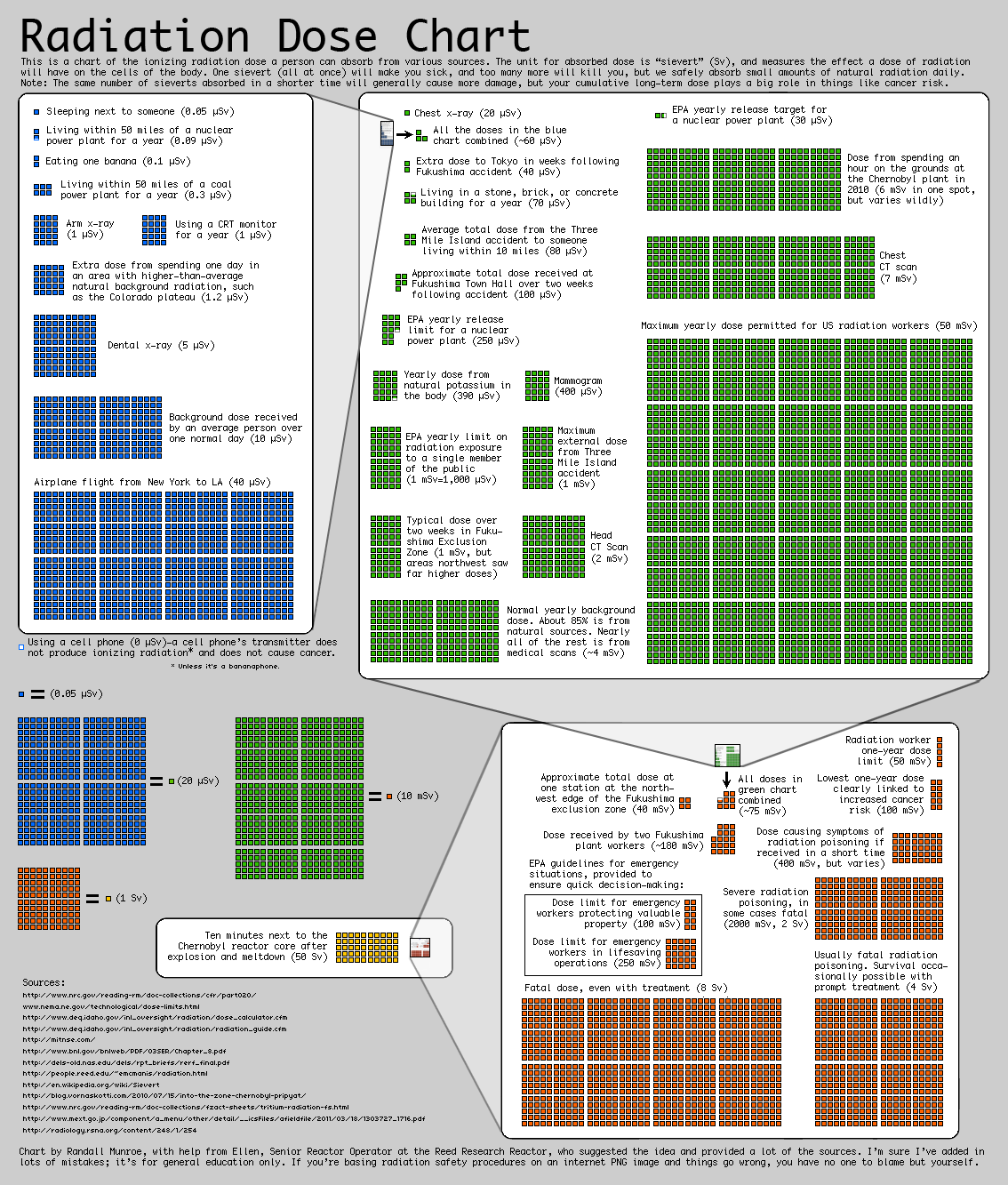
Also look at the radiation from a coal plant as shown in this diagram:

Radiation dose comparison from XKCD.com by Randall MunroeThe largest of the blue dose measures in the top left segment of the chart represents the radiation dose from just one airplane flight from LA to New York. The flying I did last year would have been enough to expose me to the dose received by Fukushima power workers.

Other of the blue squares represent the amounts flowing from the smoke stacks of coal burning electric power plants. We are frantic about tiny amounts of radiation exposure, that we are already receiving without being near any reactors.

We are panicking and frothing at the mouth about amounts of nuclear exposure that are tiny in their harmful effects compared to the smoke, and flames and environmental pollution that the rest of the tsunami and earthquake have produced.

If I had to choose between my family living downwind of a coal plant, oil refinery or nuclear plant it would be the nuke every time. If there is a forecast of a tidal wave or an earthquake - safest place to go? Your local nuclear plant.

If you dredge through the hype on Fukushima you don't see any actual figures on who was exposed to what. I have yet to see an actual report of anyone actually being harmed. Where are the workers whose rad-badges show them receiving an actual fatal or semi-fatal dose of radiation? Not one, and yet the death toll from the quake, the fires and other conditions flowing from the rest of the quake and tsunami are over 18,000 people.

What if you knew there was a power generation technology which killed in OECD countries between 1969 and 2000 a total of 14 people? Is the risk of that technology too great?

Do you say yes, 14 dead is 14 too many? Then you have consigned Hydro electric power generation to the scrap heap.

The same statistic for Nuclear power generation is zero.

For coal it is 2259 deaths.

So how has the international media got this so wrong? Apart from the hysteria and headline grabbing power of anything nuclear, the problem comes also from misunderstandings about the nature of radiation dose measurement.

There are reports of levels being measured at various locations, and spike rates being quoted as though they were constant - no actual figures of the workers (who wear dosimeters) of what they actually got exposed to.

I cannot believe how incredibly paternalistic our government and the USA are being. These demands to oversight what is happening in Japan verge on US Imperialism. And Kevin Rudd making demands on behalf of the "international community" to examine the reactors is just an outright challenge to a 1st world sovereign nation that would be warlike if it wasn't laughable.

This sort of thing happens all too often - you suddenly out of the blue hear Australian politicians and US politicians both spontaneously start singing off the same song sheet - its the intelligence briefings that they are all taking as gospel truth, even though military hawks with an eye on their budget are behind it. Same thing happened with Haneef.

In an article on this blog previously I wrote about how the same "think tanks" that denied the link between smoking cigarettes and lung cancer are now working to spread fear, uncertainty and doubt about climate change.

In Australia where there is no nuclear energy industry, its easy to forget how prevalent nuclear power is already. This represents competition, for the players in the energy sector - but what has kept nuclear down as a competitor to coal has been the cost of nuclear. Building a plant takes longer, and its approvals process is full of risks - especially for the investors in the plant. Once its built the operators of the plant must arrange to dispose of the waste - sequestration if you like - where as currently coal plant operators just spew their toxic waste directly into the air.

So what is interesting about this is that with climate change on the agenda, coal and oil industry executives are scared of a future where market dominance of their products is eroded by nuclear plants. The USA has a lot of Nuclear plants already, as shown in the map above - so does Europe, Japan and many other countries. It would be very easy to scale up nuclear plant building and scale down coal plant building & oil fired home heating (big in the north-eastern USA) if cap-and-trade or other anti-carbon measures made it economic. If coal plants were required to sequester their waste product like the nuclear industry has to, then their profits would be seriously eroded.

As a result these industry figures are cranking up their lobbying machine, and getting their PR executives and spin merchants on the job to peddle the anti-nuclear story to anyone that will listen. They're especially scared of advanced clean and safe reactor technology gaining a foothold since then their dirty and dangerous energy production will be unsaleable.

Here's a good analysis of the Fukushima situation by a British tech journalist. Summary - a 30 year old reactor, due for decommissioning, hit first by an earthquake at 9 on the Richter scale (when it was designed to cope with up to 8), and then hit by a tsunami - result no fatalities.

There are reports in the press of "people showing symptoms" but there is no science in any of this. If you have a population of thousands of scared people and ask them if they have symptoms X, Y and Z you will get a handful saying "Oh, I have that". There are zero medically or scientifically confirmed cases of serious harm radiation exposure to anyone outside the plant.

Its hard to find good data. Wikipedia has a lot of "data" on their Fukushima page but when you look at their sources, again all of the danger danger red showing on their tables is sourced from such august scientific sources as the Los Angeles Times or the New York Times, who are using words like "presumably" in their reporting

Compare all of this to the Gulf of Mexico and the BP Oil Disaster - that happened without an earthquake or a tsunami. Or Exxon Valdez.

Nuclear reactors are not killing or harming people. Just scaring them - or at least the newspapers are.

What is killing and harming people? Coal.

Coal pollutant contamination is what some people who do live near the dirty and dangerous coal plants already fear.

Thousands of people have died over the last 10 years from Athsma - and it is known that air pollution is a strong risk factor for those with athsma. Nuclear plants don't have any affect on athsmatics at all. If we replaced all of our coal plants with nuclear reactors tomorrow my bet is that those athsma deaths would drop significantly. Similar story with lung cancer and other health problems.

I believe we need to urgently act to stop the pollution from our current industrial and domestic activities. We only have one climate, we only have one environment. The worst offenders are coal plants, but the transport sector with its motor vehicles are up there too.

However our livelihood, our hospitals, schools and industries depend on energy - particularly electricity. If we are to clean up transport by switching to electric vehicles, that electricity has to be clean and sustainable. The base load power has to come from nuclear - nothing else is both clean and plentiful - wind and solar have their place, but you cannot run an aluminium smelter or a hospital or a data centre off wind and solar alone.

By fostering a safe and efficient nuclear industry now, the advances desperately needed in nuclear power generation technology can come from innovation. Thorium based reactors which we have known about for decades are now being built in China, and hold the promise of much safer, ubiquitous nuclear power with a tiny fraction of the waste.

If we falter on nuclear now, coal plants will continue and our climate and our health, and the world we leave to our children will suffer.

The writing is on the wall here - energy is dangerous. To be the safest we can be, nuclear energy is the answer.

Sunday, February 20, 2011

Time to quit


Like a 2 pack-a-day man, who's been told by his doctor to quit, Australia has been in denial.

Smoke from coal plants, and other pollution has been pluming from Aussie smokestacks throughout history, and we don't want to hear that its bad for us.

But guess, what its killing us. The image left is from a 2008 article I wrote about how strong government action on energy and climate change was urgent to counter what polluters were doing to us.

In February 2010 I wrote here on this blog about how climate change would bring significant increases in the incidence of floods, droughts, heat waves and wildfires
Just a year later, flooding in my city of Brisbane, caused death and devastation. These news shots are of an area in Milton, just 15 minutes walk from my home.

Images from Brisbane's 4BC News during Jan 2011 floods.

This was a year after deadly wildfires and heatwaves in 2009. Now flooding has swept through the Brisbane valley, killing and destroying property, ruining lives and wrecking livelihoods.

We've been told. But we didn't want to listen.

As I explained in my article in mid-2009, the pollution lobby is paying for expensive think tanks and "conferences" to throw up a smoke-screen in front of their activities. And the Idiocracy that passes for our political system has been drinking this kool-aid by the gallon.

Somehow we've suspected that all this smoke was bad, but the pollution lobby - like the tobacco lobby of 20 years ago - has been there to provide us with ready made plausible denial. And we believed it because it was more comfortable to believe that what we'd been doing so far was some how OK, than to believe we'd been wrecking the world we are leaving for our children for our own profits.

The floods and fires we have seen are like the first few spots of blood on that inveterate smokers white handkerchief. This is just the early warning.

We asked "how long before it causes real damage?"

"What can we get away with?"

Well, you know what? I've been writing this blog, about the things we can do about climate change - using public transport, using non-polluting vehicles, looking out for what we are doing to the planet - for going on 5 years now. In that time I have seen more evidence of the violent damage that polluting practices can do to our planet, than I could ever write in a blog.

Our scientists have been telling us. So what do we do? Keep going until we can find another scientist who will tell us what we want to hear.

Every smoke-stack, every tail-pipe is doing us damage. Every day.

Now. We have to stop now.

The BP oil disaster off the shores of the USA, cyclones, fires and floods killing so many. In Australia we were lucky, floods in Brazil earlier this year were worse:


This is recent history. How soon will we forget?

Right through history tycoons have profited by pressuring or paying their political cronies into allowing them to plunder our futures. In previous blog posts here I have written about how in 1949 shell companies formed by Standard Oil, and Firestone Tire & Rubber tore up and burned the electric trams of US cities.

How could they - that must have been illegal, you ask? It was, and they were charged in court, and convicted of it (read the article) - a tiny slap on the hand, as they went on to cover the US with gas stations and highways.

Those same tycoons are doing their stuff now. Duping and dealing with our politicians in order to get just one more, two more, another years worth of quarterly profit reports up and into their bonus cheques.

So what can we do? Its all hopeless then?

No its not. Yes, its a gloomy message. Yes, its not news we want to hear.

Use recycled shopping bags and take the bus or pushbike to work? Yes - do those things. However the scale of pollutions from corporates is undoing that good work faster than we can fix it.

But there are things we can do to tell our politicians that we have the will, to start to fix this mess. We can tell politicians - since there are those that have the guts to fight for this - that we are are behind them.


GetUp.org.au has recently claimed a big success in re-instantiating a government programme to build power stations using solar energy, and to instead get the required funding for the flood rebuilding from subsidies to the polluters. Movements like GetUp's Solar Flagship programme are galvanizing an Australian public who are sick of being dictated to by the captains of industry who enjoy far too much access to the corridors of politial power.

If you don't like the idea of organisations like GetUp, then get personal: do it yourself. Learn, research, become informed - and then write to the MP's and politicians. Use the internet, the phone or write letters. Or even blog posts.

But whatever you do, don't forget the 2011 floods.

Wednesday, January 19, 2011

Catching buses to QUT KG

For visitors from places without great public transit infrastructure catching buses around a strange place will be anaethema.

But for some places in Brisbane, Australia - you'd be mad not to use public transport since the new bus-way system was set up. Combined with the new Translink Go Card this system is a breeze to use, and its also clean and safe.

The air-conditioned natural gas buses are not "on the nose" (as diesel ones normally are) and run on an elevated "bus way" which is exclusive for their use, so no stop-go and jerking around like in regular traffic. Through congested areas the bus way goes down through tunnels, and is the easiest way to get across town.

The bus way is well lit, well sign-posted, fitted with security cameras and is well lit, making it a safe and easy way to get around.

Here's some popular locations well served by bus way buses.


View Larger Map

From Urbanest to QUT Kelvin Grove.

In the Google Street View image above the structure on the right is the bus way station. Urbanest is at off the left of this image, at 60 Tribune Street (which is running left-to-right in the foreground).

Take your go card, go to the station and go to the platform heading into the city. Don't worry about time tables - buses are very frequent. Check the digital display for buses arriving.

Catch the 66 bus and it will take you straight through the city to QUT - easy!

As you get on the bus touch your Go Card to the reader - no money changes hands. Nice.


Or you can get on any bus that is heading to the city, and change to a QUT bound bus at King George Square bus station.

Touch your Go Card to the reader as you get off.

King George Square is a clean, new structure only a year old - its an underground station, next stop after the Myer Center.

There, get on the 66 bus, or any other bus going to QUT Kelvin Grove campus. It will leave a few steps from where you got off on the same platform.

The 66 bus leaves from Stop E on the outbound platform - this is the stop in the photo above.

Check the BCC map of the bus station for more details.

QUT Kelvin Grove from the city.


Walk to the King George Square station. The entrance is on Adelaide St, a few steps from Queens Street Mall, near the intersection with Albert Street.

Down the escalators to the outbound platform, as in the section above.

If you see people checking tickets and so on, just vaguely wave your Go Card at them, they'll smile and wave you through. Some people still try to get on buses with loose change.

At QUT Kelvin Grove.

You can see the bus-way station in QUT's color map of the campus - its very well located right next to S block.


This photo shows the entrance to the QUT busway station.

To head south again back to the city or south bank, cross the bus way stations foot bridge which drops you onto the inbound platform without having to cross any roads or dice with traffic.

Platforms are well protected from the weather and are fitted with machines to top up your go card, or to check the balance.

Enjoy!

Monday, December 13, 2010

Paris by Wing


Just touched down at Paris Charles de Gaulle airport, and having secured an over-priced coffee and croissant your intrepid reporter goes in search of transport to the city.

There, framed in the doorway from the arrivals lounge, a suave local proffers his card: "motorcycle taxi". In halting English, the raffish blade echoes the cards dangerous message: "motorcycle taxi?".

I think I was in, from the part about the motorcycle.

Right outside the door to the terminal, in the dedicated motorcycle parking are not one, but four Honda Goldwings. The presence of the 'wing - the flagship of japanese motorcycle touring and a princely investment for most motorcyclists - in these numbers indicates not just some lone wild entrepreneur in the niche market of one-up travelling light passenger transport.

Turns out its a local custom.

I was interested to see how this could possibly work, with my roll-aboard and laptop bag, but now I started to see that all the issues had been worked out.

Next to me a gallic-looking gentleman off the same flight was loading his considerably larger suitcase on to the luggage rack of an already running 'wing. I had always thought those things were just for decoration - but with some webbing (ocky straps to you Aussies) and a few deft twists the top-heavy looking load was secured and they were off.

While my driver - errr rider - was at the handle-bar mounted GPS punching in the address of my hotel I donned the thick jacket, gloves and helmet. My laptop bag fitted easily in one of the capacious panniers.

Hmm - what was I thinking, part of me said, thinking now of how the pilot on the plane had announced -1 degree celsius temperatures on the ground in Paris as we landed.

No problem - not only did the 'wing turn out to have a heated rear seat, but it was also fitted with a nifty windbarrier for the rear-passenger. Secured to the bike down the frame where the passengers legs go, and then over the seat, this heavy-duty gore-tex style piece of kit effectively covered the whole lower half of my body once on the bike. Nice and toasty!

In a minute or two we were off. I soon saw what the attraction of the bike taxi was for the locals - dealing with the congestion on the motorways, in classic European driving style.

If you've ever been a rider, you'll know what lane splitting is. Also called filtering, or sharing, the practise is a bit hair-raising when you first try it, in the relatively safe slowness of stop-go traffic. There's a little thrill of the slightly illicit, when you cruise between stopped cars to take up a position on the front of the grid at traffic lights. Narrow waisted sport bikes, and scooters are ideal at this sort of thing.

Now take that, and multiply it by 1000.

You have a Honda Goldwing - six cylinder highway beast, at least a meter wide, plus mirrors, travelling along at 100 kpm (that's about 60 miles per hour) between cars and trucks with an inch to spare.

Strangely I was not scared. Dumb-founded. Amazed. Didn't have time for scared.

How the hell was he doing it? Without us dying?

At one point we passed a large Fiat van on one side, and on the other a Citroen was backed over as far as it could toward the barrier and as the 'wing passed thru a gap that I didn't think was there a "clack!" annouced that we'd tipped something against the van on the way through.

I think in engineering circles they call that an interference fit.

It was a feat that was being accomplished in equal parts by skill and split-second judgement, by some sort of Nietzsche-esque nihilism, and by a lot of co-operation with other Parisian road-users.

After we'd been on the choked up highway for some time, I noticed that my rider had both blinkers going, and was using his headlight to flash traffic in the fast lane. I say "fast lane" tho' the traffic was doing around 50 kph in the congestion - but we were doing twice that. Occasionally he would use his horn when the expected gap didn't open up.

Most motorists were completely aware of what the light show coming up behind meant - in the fast lane (the left most lane in Europe) cars would hop to the left, and the next lane over they'd squeeze a little to the right.

The pilot of the 'wing would gun the big six and surge thru just as the gap opened up.

The fact that I'm typing this is a testament to the fact that I survived.

I'm still not sure how.

But I want to do it again anyway.

Vive la différence!


Sunday, December 5, 2010

LCA just got even better

LCA2011 venue - the QUT Z-Block complex
In January 2011 free & open source rockets - like, you know, space rockets - free & open source software, and more free and open source good will than you can shake a stick at all come together for linux.conf.au, in QUT's flash facilities (photo left) at Brisbane's beautiful Gardens Point.

And there's another reason why LCA is going to be even better this year.

LCA has long been the most vibrant and enjoyable grass roots technical conference on this side of the equator, but it has - like many other technical conferences - had its share of incidents that pretty sorely detract from that inclusive and productive community spirit.

Yuk. Harassment.

Its not pretty, and we'd all rather we didn't hear about it. But its been pooping on our doorstep for sometime now.

And its time to clean house.

Our broom is the new LCA2011 anti-harassment policy.

It went live on the LCA 2011 site last night and already we're getting a lot of great buzz.

Several of us on the LCA2011 organizing committee, led by yours truly, have been working really hard with the community both in Australia and abroad to pull together this policy - something that can stand against the awful trend; that can help to make LCA more welcoming to a whole range of people who maybe have been put off technical conferences because of that atmosphere.

We hope this will clear the air. It will show that we stand behind the fine print in our T&C which also gives a mention to harassment.

We're also hoping it will provide the courage for other future technical conferences to do their own policy as well.

A lot of the success of our effort has come from standing on the shoulders of the Conference Anti-Harassment Project, championed by Val Aurora and friends. And it has been helped by discussions and input from a whole range of people - you know who you are: thank you!

Got questions? Got thoughts?

Please, leave them here - but can I encourage an approach of first please - most graciously - read the Conference Anti-Harassment resources. If the issue is already answered there its probably just going to attract a "Read the Fine Manual" sort of response. :-)

Thanks for reading, and I look forward to seeing you all at Linux.conf.au 2011.

Why are you still here - go and register!