Showing posts with label hybrid. Show all posts

Friday, April 19, 2013

The Next Electric Cars

We've had over a century of development on fossil-fuel powered vehicles.  It was a time when the requirements of motorists and the romance and passion of motorsport combined to produce improvements in cars that were about sensible things such as economy and ride quality; but also the things that get petrol heads out of their seats like top speed performance, handling and acceleration.  It was a time when cars went from being expensive, dangerous and noisy rattle-trap playthings for the rich, to being fast and practical transport for the many.
The 1915 Detroit Electric

During that time sadly virtually no progress was made on a automotive propulsion batteries or electric vehicle motive power.  The Electric Vehicle arrived on the scene around the same time as the Internal Combustion power car, and while the EV was supreme in the cities, through accidents of history and industrial conspiracy which you can read about in Edwin Black's "Internal Combustion" the EV passed into the annals of history.

Electric Citicar - Southward Auto Museum, New Zealand

Technologists and even motor companies dabbled in electric vehicles during that 100 years, but saw them as toys and quirky golf-cart size "personal transports", like this "Electric Citicar" made between 1972 & 1978 by Sebring-Vanguard.  Really these sorts of vehicles were new bodies on the old technologies no better than the lead-acid batteries of the Detroit Electric 60 years previous.  They were light-weight experiments instead of real full-blown motor cars.  So called electric "neighbourhood cars" still produced today are still evidence of this lack of progress.

Until now.

Photo of the Porsche 918 from GizMag
The 2013 Porsche 918R Hybrid 770bhp 3s 0-60 (gizmag.com)
Now with crises in air quality in our big cities, the effects of global warming and pollution in general on our planet, and the need for energy security we are seeing a resurgence in electric vehicle technology, and electric vehicles on the production lines of many of the world auto makers.

We are also seeing high-performance vehicles powered by electric motors on our race tracks.  Vehicles like the incredible Porsche 918 Hybrid.  While it does have a petrol power-plant on board as well, the 918 can run on pure battery power, and with advances in batteries (see below) Porsches technology will no doubt be seen in future all electric vehicles.  The point is that the electric power train is already seen by high-performance motor engineers as the way forward.

I drive a Nissan Leaf: a practical all electric passenger sedan with a range of 175km and performance equal to or better than similar sized fossil-fuel powered cars.  The Leaf has no exhaust pipe and produces zero emissions, so as I drive past schools and sidewalk cafes I can be sure I'm not ruining the air quality for my fellow city dwellers.  I don't have to make a regular pilgrimage to buy fuel at gas stations, and any time I go down to the car in my garage its there ready to go, charged up for free courtesy of the solar panels on my roof.  Its a clean machine.

But electric vehicle development is not stopping there, and its interesting to wonder how far behind we are after our 100 year sleep, and how quickly we can catch up.  Look at the speed of the cellphone revolution for examples of the speed of innovation we can expect.

There are a couple of things to be said about this catchup process - first is that electric cars while already good, they are only going to get better.

Motor-sports aficionados already recognise the applicability of the new technologies in EV and hybrid power, so we are seeing a new age where the petrol-head becomes the electron-head, as speed and handling come from improvements in electronic and electric drive technology.

One example is the active steering and suspension on the Porsche which has many new freedoms for designers of high-performance cars due to the flexibility electric drive gives you.  The old CV joint and half-shaft, or conventional differential and driveshaft setup of petrol powered vehicles meant many restrictions on what can be achieved.  Porsche engineers are breaking out of these paradigms with the 918 and setting new performance benchmarks as they do so.

exploded image of in wheel motor and tyre
Protean in wheel motor (cleantechnica.com)

In wheel motors promise huge advances in this area, effectively giving 3 degrees of freedom for suspension geometry design and active (computer controlled electronic) suspension and drive systems.  Protean claim also much improved regenerative braking energy recovery.  While in-wheel motors have a challenge with unsprung weight that is outweighed many times over by the prospects for fully active suspension, steering and drive that comes from an in wheel motor.
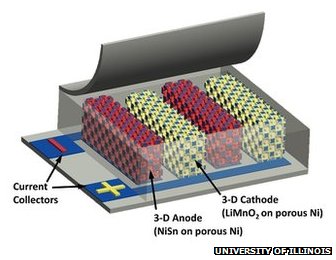
graphic interpretation of the micro battery architecture with tiny interleaved cells
University of Illinois interdigitated battery architecture (BBC)

This new battery technology unveiled just days before I write this article comes from the University of Illinois and promises power outputs 10s or 100s of times better than current battery technology.

Update: (thanks Russell!) it was pointed out that the U of Illinois battery is more about power output than watts per size (energy density, or capacity).  Other projects are promising big improvements in EV range from higher battery capacity, such as the 3 x lithium-air chemistry and 10 x aluminium-air projects, like the one from Phinergy (although the latter one is currently not rechargeable).

With that sort of energy density my Nissan Leaf would have over 1000km of range on a battery half the size of the one it currently has.  Countries that want to improve air quality in their cities while keeping up with the bleeding edge of technology in transportation are investing heavily in the R&D of battery technologies.

Fossil-fuel powered cars will still be around for a long time, but their golden age has past now.  No matter how good you make internal combustion engines, they rely on foreign oil and produce pollution.  Yes, there are ethanol and other bio-fuels now, but in practice you have to buy E10 or other mixes with petrol.  In theory diesels and flex-fuels can use 100% bio-fuels, but its not available now and production in quantity appears to be neither economically viable or environmentally sustainable.

Advances in internal combustion powered vehicles show fewer and fewer returns for R&D dollars spent, compared to electric.  There's no flux capacitor or magic catalyst that is going to improve petrol 10s or 100s of times over.  ICE cars are about as good as they can ever be and no promised fuel technologies are coming to change that.

I'm driving my 100% emissions free sun-powered electric vehicle today.  Right now.  No theories, no corn subsidies, all real.

Now the point of all this is that the way ahead for Electric Vehicles is expanding and full of promise.  Every new advance brings large improvements in practical areas like range, and carrying capacity.  When EV's are powered by clean sources like my solar panels the entire personal transport experience is of low impact to our environment.

How far can the Electric Vehicle go?  I'm excited to find out.

Monday, March 15, 2010

The Prius Juggernaut

Final update:

The Toyota Prius stuck pedal is a hoax - its official now with multiple news sites reporting it:
...and many more.

Interestingly enough Steve Wozniak, co-founder of Apple has also owned up to his freaky stunt, saying that he too had been hoaxing, after being reported as having said his Prius had a stuck-accelerator.

Seems that TV reporters were all too keen to hear any story about Toyotas back then, and if you wanted to get on TV that was how to do it.

Further udpate:

This excellent video from edmunds.com - a US car review website - has a great demonstration of the all-weather car mat problem, and a very sane discussion of unintended acceleration.

If you really are interested in stopping so-called unintended acceleration then following the advice given in this video to put your car in neutral is the way to go.

For those that remain convinced that electronic gremlins in the fly-by-wire systems on cars is the cause, and that we should all go back to mechanical throttles because they were oh-so reliable I still await any evidence of this. The fact is that electronic throttles which cut out the engine when the brake is fully depressed, as the Prius does, are much safer than any mechanical linkage.


Update: a recent report of a collision with a wall after 56 year-old driver in New York state experiencing "unintended acceleration" in her Prius has been determined by the NHTSA to be a case of driver error. The NHTSA said
Information retrieved from the vehicle's onboard computer systems indicated there was no application of the brakes and the throttle was fully open.
What irritates me no end is that the original "breaking news" reports were stated in a way that conflated drive-by-wire with unintended acceleration. Now that the NHTSA have ruled it was driver error - the owner simply panicked and jumped on the wrong pedal - do you think there will be a breaking news retraction?

Meanwhile Prius has been rated the "Most Dependable Car" in a recent survey. But such stories don't compare for headline grabbing shock-horror value stories about out of control drive-by-wire that technophobes lap up with glee, even when they're proven to be completely bogus.

I'm on my third Prius. When an electric car becomes available here in Australia I'll buy that, but until then Prius is the lowest emissions option, with far better carbon footprint than any car in its class.

It's spacious - easily carrying 4-5 adults and baggage, has plenty of power, and an excellent standard of finish, and accessories.

When I got my first one - they were rare as hens teeth. I even joined a Prius car club. Seeing one on the road was cause for excitement. People at work marvelled at the LCD display, and the electronics under the hood.

Then over to the USA and my second Prius - they were a lot more popular there, especially so in California.

The image left is of that Prius, an 07 iTech with all the bells and whistles, sitting rather cheekily in the car park of the Tesla HQ in Silicon Valley.

Now in 2010 Prius is everywhere, even in backwater Brisbane, Australia. In my small work car park alone, there are 3-4; Prius taxis queue up behind each other in city cab ranks; and Prius drivers sail past each other on the roads without the slightest frisson of excitement or recognition.

It seems there is no stopping the juggernaut of Toyota's marvel car, as they struggle to keep up with demand, and win award after award with it.

Of course now that Prius is popular, that means a lot more people are driving them.

And guess what - that means idiots are also driving them.

Was just checking the news websites via Google news, and a number of mostly conservative news sites, like Fox news, are reporting a piece about the Police in San Diego helping a Prius driver with a stuck accelerator slow his vehicle. The piece was originated by the San Diego Tribune and syndicated by AP.

The article also comments that a Police officer was killed recently in a Toyota stuck accelerator incident, and that Toyota are involved in a recall at present.

These sorts of reports are often phrased in a way that to the casual reader sounds like all Toyota vehicles are death traps waiting to close around their next victim. The front page of the Economist has carried a recent story about Toyota slips up. Certainly seems like the world has got it in for Toyota.

Anyway - that "sudden acceleration".

Some additional facts are that the Police officer in that case was off duty, driving with his family; and the vehicle was a Toyota Lexus 4WD. The car also contained the driver's brother-in-law who phoned 911 during the incident.

The vehicle was a loaner car, while the driver's regular vehicle was being repaired. The fact that the vehicle was a loaner makes it more likely that the driver was unfamiliar with the engine on/off switch. There is no evidence that he attempted to put the car in neutral.

There was a recall last year for floor mats entrapping the accelerator pedal in some Toyotas - as far as I can tell this is what is being blamed for this 4 person fatal crash, in the preliminary reports.

The recall also involved packaging changes to instruct drivers in the proper installation of the all-weather floor mats which could slide forward if not fitted properly.

There is a Toyota current recall, but its only for some newer models, and relates to the braking of the car at very low speeds. Nothing to do with the accelerator.

There has to date been no investigation outcomes supporting any problems with the electronic throttle on Toyota vehicles as far as I know. However much of the hype out there is drumming up the notion that electronic throttles are to blame, and Prius electronics in general are faulty.

However Toyota have to manage possibilities, and also try to avoid problems that could make it easier for drivers to make errors. It has to manage perceptions, and if people experience things that they don't expect, and which could cause them to panic.

This is one of the reasons why our USA Prius had the EV switch removed - it was yet another thing that might "freak out" US drivers.

So.

I have been interested to discover what is behind all this publicity of stuck accelerator and failing brakes.

Any Police officer will tell you they are always suspicious of any reports made by drivers of vehicles, especially drivers who have been involved in collisions, or high-speed incidents. There can be some quite amazing behaviour and reports from drivers when they are on the face of it at fault in an collision; or when they suddenly notice that there is a "speed trap" and that they might have been detected by it.

I'm not saying at all that there are no valid reports - I'm just saying that reported incidents need to be carefully corroborated, using an evidence based approach.

In particular when serious incidents have occurred the cars are very very meticulously examined for mechanical and electronic/electrical faults by Police and Transport Authorities to determine if anything about the vehicle contributed to the collision. Where there is any corroboration at all from those examinations, or from examination of the scene and other eye-witnesses, then these reports need to be taken very seriously indeed.

A couple of other salient facts - there are a large number of lawsuits open at present for "Sudden Acceleration" - sites like http://suddenacceleration.com/ offer to find you good lawyers for your Sudden Acceleration Syndrome claim. This "Sudden Acceleration" syndrome has been around for 20 years now, and has become a nice little earner for lawyers.

If enough hype can be gathered about a particular vehicle, then there's plenty of instant whiplash victims donning their foam collars and ringing the local ambulance chasers to join the class action. For some this is better than working for a living apparently.

This wikipedia article is very interesting, and has a great history of the "sudden acceleration phenomena".

Basically after years of pursuing the Audi 5000 there was never any evidence for the claims of unintended acceleration - the class action lawsuit that was launched by several people reporting "Sudden Acceleration" was eventually lost after an expert who they called was involved with rigging an Audi to exhibit the fault for a television program.

The reports have been determined to be due to driver error such as hitting the accelerator pedal believing it to be the brake, or the pedal becoming stuck against some loose object in the footwell.

Note that in the case of the Audi there were recalls - to fit an accelerator pedal that was further away from the brake pedal. Its common apparently for sports cars to have the two close together for high-performance driving, but here the car was dumbed down for the american driver.

This article has a skeptical view of the Prius stuck accelerator reports.

My own view is that the vast number of these complaints are actually caused by cruise control. The reports in these incidents involve cruise control.

In this account:

I felt the vehicle [2008 Lexus ES 350] increasing in speed to about 90 mph, without depressing the accelerator. I had been on cruise control at about 73 mph... [A] passenger screamed at me to slow down. I was unable to do so, even after stepping forcefully on the brakes.

If the vehicle has been on a steady decline or level surface and encounters an incline, neighbouring vehicles not using cruise control will tend to slow down. However in a vehicle with the cruise control on, it will increase engine revs and in automatic cars drop to a lower gear.

A sudden call for extra power by the cruise control in this situation causes the motor to rev up quite dramatically. This should all be expected because you have asked the vehicle to maintain a high steady speed, and now on the incline much more power is required to acheive that. At the same time other vehicles in neighbouring lanes appear much slower by comparison.

If a driver has been at the wheel for a long time, in a steady stream of traffic, using cruise control, their alertness and attention to the road may wander. This is especially so if there are other distractions in the car. Suddenly the engine revs up, other vehicles out the window are going relatively slower - and a 10 km difference in speed versus the traffic will look like you are roaring along.

Now the driver who has had their feet away from the controls suddenly panics and tries to slow the vehicle - in this case it can be easy to misapply the controls, jamming the foot onto the accelerator, or getting both the brake and the accelerator.

I suspect a large number more of these reports are due to obstructions in the footwell of the car - like the improperly fitted floor mats in the Toyota cars. The remainder I would put down to driver error - fatigue, distraction and all the rest.

They go and jam their foot on the wrong pedal.

Whether its the cruise control thing, or footwell obstructions, putting the car in neutral and applying the brake always works.

There are I would say hundreds, thousands of drivers out there who have experienced problems from cruise control or footwell obstruction - they've put the vehicle in neutral and applied the brakes and all has been OK. However the ones who fail to control the vehicle - are they going to ever say there was something that they could have done? Nope, the damages - especially the more severe they are - are the fault of the vehicle manufacturer, the evil corporation.

The trouble with the litigious society is that it results in dumbing down of everything and poorer results for the rest of us that are able to drive and generally behave responsibly.

My view is that it is extremely unlikely that there are any valid actual incidents of something going wrong with the electronic throttle on any vehicles. You should start worrying about precautions for electronic throttles about the same time as you do for meteors falling on your head. The chance that that is true is far outweighed by the safety advantages of the electronic throttle, which for example automatically cuts out acceleration when you apply the brake (as mentioned in the allaboutprius article).

Here's yet another story about a woman who reported her Lexus going out of control. Her complaints were rejected by Toyota and also by the NHTSA - now here she is in a congressional hearing saying that the NHTSA aren't doing their job properly. The comments make for interesting reading.

I'm sure she experienced something horrible and frightening. However we need to get over the fact that not everything has to be someone else's fault.


Some more developments on the case of the "runaway Prius":

Turns out that
  • Toyota are stating that what he reports - that brakes were applied but the car kept accelerating - is not possible, and this was confirmed by tests both by Toyota and the NHTSA, while an observer from the congressional hearing was in attendance
  • The CHP - both the officer following the vehicle and the 911 operator - told him to put it in neutral over the course of the 27 minutes incident - he did not
  • Sikes, the driver of the Prius in the reported "sudden acceleration" case is a bankrupt, has a large debt, and has retained a lawyer
Commentators on blogs are comparing the thing to the "Balloon Boy" incident - where the news gets hold of something happening in "real time", but it turns out to be all faked.

Here is a guy who finds his car accelerating out of control, so he calls 911?? You're driving an out of control vehicle so you get on the phone?

But you don't try to put the vehicle in neutral, or press the engine off switch? You don't even have to move your hand from the wheel to put the car in neutral on the Prius - the stalk is right there on the dash.

I'm afraid my bullsh*t detector just tripped up into the red zone....