Showing posts with label electric cars. Show all posts

Friday, April 19, 2013

The Next Electric Cars

We've had over a century of development on fossil-fuel powered vehicles.  It was a time when the requirements of motorists and the romance and passion of motorsport combined to produce improvements in cars that were about sensible things such as economy and ride quality; but also the things that get petrol heads out of their seats like top speed performance, handling and acceleration.  It was a time when cars went from being expensive, dangerous and noisy rattle-trap playthings for the rich, to being fast and practical transport for the many.
The 1915 Detroit Electric

During that time sadly virtually no progress was made on a automotive propulsion batteries or electric vehicle motive power.  The Electric Vehicle arrived on the scene around the same time as the Internal Combustion power car, and while the EV was supreme in the cities, through accidents of history and industrial conspiracy which you can read about in Edwin Black's "Internal Combustion" the EV passed into the annals of history.

Electric Citicar - Southward Auto Museum, New Zealand

Technologists and even motor companies dabbled in electric vehicles during that 100 years, but saw them as toys and quirky golf-cart size "personal transports", like this "Electric Citicar" made between 1972 & 1978 by Sebring-Vanguard.  Really these sorts of vehicles were new bodies on the old technologies no better than the lead-acid batteries of the Detroit Electric 60 years previous.  They were light-weight experiments instead of real full-blown motor cars.  So called electric "neighbourhood cars" still produced today are still evidence of this lack of progress.

Until now.

Photo of the Porsche 918 from GizMag
The 2013 Porsche 918R Hybrid 770bhp 3s 0-60 (gizmag.com)
Now with crises in air quality in our big cities, the effects of global warming and pollution in general on our planet, and the need for energy security we are seeing a resurgence in electric vehicle technology, and electric vehicles on the production lines of many of the world auto makers.

We are also seeing high-performance vehicles powered by electric motors on our race tracks.  Vehicles like the incredible Porsche 918 Hybrid.  While it does have a petrol power-plant on board as well, the 918 can run on pure battery power, and with advances in batteries (see below) Porsches technology will no doubt be seen in future all electric vehicles.  The point is that the electric power train is already seen by high-performance motor engineers as the way forward.

I drive a Nissan Leaf: a practical all electric passenger sedan with a range of 175km and performance equal to or better than similar sized fossil-fuel powered cars.  The Leaf has no exhaust pipe and produces zero emissions, so as I drive past schools and sidewalk cafes I can be sure I'm not ruining the air quality for my fellow city dwellers.  I don't have to make a regular pilgrimage to buy fuel at gas stations, and any time I go down to the car in my garage its there ready to go, charged up for free courtesy of the solar panels on my roof.  Its a clean machine.

But electric vehicle development is not stopping there, and its interesting to wonder how far behind we are after our 100 year sleep, and how quickly we can catch up.  Look at the speed of the cellphone revolution for examples of the speed of innovation we can expect.

There are a couple of things to be said about this catchup process - first is that electric cars while already good, they are only going to get better.

Motor-sports aficionados already recognise the applicability of the new technologies in EV and hybrid power, so we are seeing a new age where the petrol-head becomes the electron-head, as speed and handling come from improvements in electronic and electric drive technology.

One example is the active steering and suspension on the Porsche which has many new freedoms for designers of high-performance cars due to the flexibility electric drive gives you.  The old CV joint and half-shaft, or conventional differential and driveshaft setup of petrol powered vehicles meant many restrictions on what can be achieved.  Porsche engineers are breaking out of these paradigms with the 918 and setting new performance benchmarks as they do so.

exploded image of in wheel motor and tyre
Protean in wheel motor (cleantechnica.com)

In wheel motors promise huge advances in this area, effectively giving 3 degrees of freedom for suspension geometry design and active (computer controlled electronic) suspension and drive systems.  Protean claim also much improved regenerative braking energy recovery.  While in-wheel motors have a challenge with unsprung weight that is outweighed many times over by the prospects for fully active suspension, steering and drive that comes from an in wheel motor.

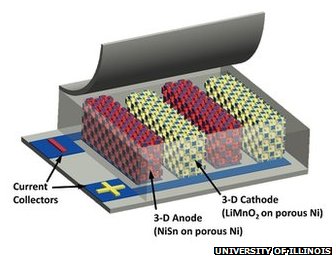
graphic interpretation of the micro battery architecture with tiny interleaved cells
University of Illinois interdigitated battery architecture (BBC)

This new battery technology unveiled just days before I write this article comes from the University of Illinois and promises power outputs 10s or 100s of times better than current battery technology.

Update: (thanks Russell!) it was pointed out that the U of Illinois battery is more about power output than watts per size (energy density, or capacity).  Other projects are promising big improvements in EV range from higher battery capacity, such as the 3 x lithium-air chemistry and 10 x aluminium-air projects, like the one from Phinergy (although the latter one is currently not rechargeable).

With that sort of energy density my Nissan Leaf would have over 1000km of range on a battery half the size of the one it currently has.  Countries that want to improve air quality in their cities while keeping up with the bleeding edge of technology in transportation are investing heavily in the R&D of battery technologies.

Fossil-fuel powered cars will still be around for a long time, but their golden age has past now.  No matter how good you make internal combustion engines, they rely on foreign oil and produce pollution.  Yes, there are ethanol and other bio-fuels now, but in practice you have to buy E10 or other mixes with petrol.  In theory diesels and flex-fuels can use 100% bio-fuels, but its not available now and production in quantity appears to be neither economically viable or environmentally sustainable.

Advances in internal combustion powered vehicles show fewer and fewer returns for R&D dollars spent, compared to electric.  There's no flux capacitor or magic catalyst that is going to improve petrol 10s or 100s of times over.  ICE cars are about as good as they can ever be and no promised fuel technologies are coming to change that.

I'm driving my 100% emissions free sun-powered electric vehicle today.  Right now.  No theories, no corn subsidies, all real.

Now the point of all this is that the way ahead for Electric Vehicles is expanding and full of promise.  Every new advance brings large improvements in practical areas like range, and carrying capacity.  When EV's are powered by clean sources like my solar panels the entire personal transport experience is of low impact to our environment.

How far can the Electric Vehicle go?  I'm excited to find out.

Wednesday, June 13, 2012

Leaf: the car evolves

Since 2007 I have been researching, writing about and advocating for electric cars.

These cars produce no emissions.  Since they do not need fossil fuels like oil or petrol, they are cheap and efficient to run, and provide energy security.

Now for me, finally, electric cars are real.  In Australia, this forgotten corner of the world where we are still digging coal out of the ground and shipping and burning it at a crazy rate, EV's are not just a dream.

Can you remember when mobile phones were just something that rich people in limousines used?  When they were a prop for Wall Street types, looking stylish while they flipped out their Motorola StarTac phones?

Back then we said things like "Oh, do you have a normal phone number?  I don't want to make an expensive mobile call!"

Now the idea of having to go anywhere, let alone a phone booth, to make a call is ridiculous.  Want to make a call?  You just pull your phone out right there, and call anyone.  All your friends numbers are stored right there in your phone.  Looking up a phone number in a book?  Weird!!

Cell phones.  It's the way phones should be.  Ask any teenager.  Try to explain to them how phones used to be and they'll look at you like you're a freak.

In 20 years time that's how it will be with cars powered by fossil fuels.  The teenagers of 2032 will tell you that the only people who use petrol cars are old people, cranks and freaks.

You had to drive your car to some special place - what's it called?  A gas station?  And they had these pumps where you had to queue up and pump fuel actually into your car?  No way - that's medieval.  Like lamp oil and stuff.

It's true!  And you know what?  When electric cars first came out people said they'd never catch on because you can't drive half-way across the state on one battery charge.  There was a name for it - they called it "range anxiety".

Why would anyone ever want to drive for hours and hours!  That's nuts.  If you're going to another city just catch a train or a plane and micro-rent when you get there.  You old people are hilarious.


But those old cars where you put petrol in them, they had big tanks, and so it turns out that they could go for 500 miles on one fill of gas.  People felt that gave them independence.

Independence, when you're chained to getting this gas stuff from some shop you have to find on the side of the road?  That's as weird as those phone booth things you were telling me about!!

But you know what, most of the time what it actually meant is that you were always worrying about when your gas would run out.  Because in fact you never really went for 500 mile road trips.  What you really always did was drive to work, and on the day when you absolutely did not want to be late, you'd jump in your car only to find you didn't have enough gas to get to work.  And you'd have to go to a gas station, instead.

You know what I think?  This range anxiety?  That is where its really from, right there.  I never worry about how far my car can go because its always charged up and ready to go.  Yeah - I love you old people and your funny stories.


Well I'm happy to be one of the first dinosaurs to evolve.  Why don't you join me?

Tuesday, July 12, 2011

Driving iMiev


This morning - a cool but sunny Queensland winter's day - I responded to an invite from Mark Whyte, iMiev Account Manager for Mitsubishi Motors Australia Ltd (MMAL) and went for a test-drive of the first production Electric Vehicle to hit Australian shores: the Mitsubishi iMiev.

Whyte - based in Adelaide but attending in Brisbane for this event - says that maybe Tesla was the first to take orders for an Australian production EV but adds that MMAL is delivering iMiev's ordered now, in August - where as Tesla customers are on year long waiting lists.

The car in its bright RACQ promotional paint job was waiting behind the showroom as I arrived - I'm guessing the RACQ who are one of MMAL's early adopting partners had loaned it for the day.

A couple of EV enthusiasts were waiting on their turn behind the wheel, and we got talking. They both felt that the time for home conversions and retrofits was coming to a close, and that cars like the iMiev would soon be taking what market there was for that. Even at $50,000 the brand new iMiev is a better proposition than a 15 year old car that you've spent $30,000 on converting to an EV, the guys said. But the price for either is a bit rich for most ordinary motorists, without Government incentives and infrastructure benefits.

After trading some general comments about EV's with those guys and the MMAL staffers, it was apparent we were all members of the choir. We know EV's are great, now let's see how this one drives.

The cars first impressions were that its much roomier inside than its quirky bug-like exterior would lead you to believe. By pushing the wheels out to the four corners and putting most of the mechanicals into the floor pan, the cars designers have been able to fill most of it with passenger and cargo space. The rear hatch opens into a sizeable cargo space for a micro car - much bigger for example than that in my current ride, a Fiat 500C. With the rear seats forward it would make a great delivery vehicle for small businesses like a florist or pizza delivery.


The drivers seat had room for my 5' 10" without any problems - but those over six-foot might start getting snug. The MMAL rep who accompanied me in the passenger seat was at arms length and there was plenty of room in the cockpit despite the small overall footprint of the car.

On moving off the cars silence and sure smoothness reminded so much of the Toyota Prius, which typically would be on battery as it first moved away from a stop. To me that was very normal - but what was awesome and spread a big grin on my face was that that experience just kept on, as we gunned around the city streets. There was some hum from the tires, a background whine - something about the ABS according to my passenger. Generally NVH issues (noise, vibration and harshness) in this tiny car were better than many large passenger sedans I had been in, and certainly impressive next to micro cars like the Fiat.

The car went exactly where I pointed it, partly perhaps due to the right-up-front positioning of the drivers position, but also a result of a very nice electrically assisted steering system. The low weight of the batteries gave the car a solid stance on the road and made it much better mannered over choppy side streets than I had expected.

I kept the car in normal drive mode for the whole time virtually and was impressed with the take off speed at lights. Not super fast but very respectable and the zero lag from the electronic throttle combined with the EV power train to make a lively response without any thought on the lights turning to green. The gear shifter will also go into an Eco mode, but I'm too much of a leadfoot to stay with that for long, and if I owned the iMiev knowing I get 100% green power at home I would have no qualms about using it.

Presiding over the iMiev's console display is a large "rev counter" like instrument that shows when charge is being used - ranging from green to white for hard use - or when it is being gained, as in slowing or regenerative braking. Mounted inside that is the speedo - something I didn't like so much as it was an LCD display and could have been more user friendly, perhaps like the Prius one which is brighter and mounted right up by the edge of the windscreen. To either side are a "fuel" gauge and range display. The range is based on your current consumption, so if you start going more gently or use Eco you'll see it jump up slightly. When you amp up the air-con (for example) it goes back down.

The controls including the leather covered steering wheel were all very natural, and normal car styling - away from the instrument panel nothing gave away the fact this was an EV. Mounted in the center of the dash was the Sat-Nav, which also doubled as a in vehicle information system. From my time with the Prius iTech I know how good an integrated sat-nav with a large screen can be. I can never look at those poky little suction cup mounted ones and think of them as real nav's and it would be great to have one again.

Coming back into the MMAL yard the car had in just a short time pretty much gotten me convinced. Mitsubishi has made no mistakes here and come up with a brilliantly practical zero-emissions vehicle that most conventional car motorists will quickly find familiar.

Charging and EV practicalities will be one hurdle. MMAL offers roadside assist for the iMiev, to help out new adopters if they have trouble. Whyte candidly says that they have had a lot of calls for battery issues. But all of them (bar one or two) were for the same problem: folks getting out of the car and leaving it running. Because the iMiev makes no noise leaving it in "idle" state is easy enough to do but of course whilst its sitting there, its using up the accessory battery (a conventional 12v cell under the bonnet). So nothing to do with range or merchant of doom battery problems - but real early adopter issues nonetheless.

Part of the problem here is that these folks were fleet users and not accustomed to EV's making no noise. To address the issue, MMAL have the next bunch of arrivals fitted with a standard "ignition lock" style key which you have to turn to the off position before you can withdraw it. Its a shame because the the keyless entry is a great feature. Maybe EV cognoscenti will be able to arranged to have it retro-fitted given that it won't be used by fleet types.


I asked Whyte about the street bollards and he showed me a few that might be coming our way. It will make a big difference to the attractiveness of EV's if dedicated bays are available, and of course the chance to add some charge is even better. What if local wags decided to unplug you? What about rain and surface water?

In this shot Whyte holds the J1772 charger that comes with the iMiev and you can possibly make out two great features. One is the locking catch which prevents casual interference. Probably good to stop the kids playing with it in the garage too. The second is the breakout box on the cable which servers as an earth-leakage current breaker - in case of shorting it will cut the power, and also the extra sender cables which also cause the cable to go inert if it is withdrawn from the socket on the car. Nice features which will allay the concerns of many motorists worried about high voltage driving.

The question is what will those motorists make of the high price. Well the first thing it say is that its not bad for an EV - the Tesla is 4 times that price. But the second thing is that in my view we need to think about what we value - look at cars you get for $50,000. For example a 2007 HSV Holden Senator. It offers performance and a "conspicuous consumption" profile. Apart from that it just gets you from A to B, the same as any other car. A 2010 BMW 120i - probably economical enough but offers you the BMW name. So what would you like to have: HSV performance, or zero petrol use? BMW name or zero emissions? Seriously - what is cooler, a gas guzzler or a car that runs on electrons?

There are a lot of people who think its just fine to spend $50,000 on a car - it is just that we have to be honest about what it is we think is worth paying for. A name? Zero to sixty in 7 seconds? Or zero foreign oil, no emissions and the convenience of never having to go to a gas station.

Monday, March 28, 2011

All Clear for Clean Nuclear Power


Japan was recently struck by a natural disaster of unprecedented scale. A one-two punch of an 8.9 strength earthquake, followed minutes later by a massive tsunami wave.

But the worlds great powers are worried about the impact of the disaster, not for the Japanese, but for its possible nuclear risks. Instead of the usual concerns for citizens whose lives and livelihoods have been destroyed in this terrible disaster, all we hear are calls in imperious tones for the Japanese to surrender to international inspections of their nuclear facilities.

Wait, when did the USA start treating Japan like it was North Korea? What the hell is going on here?

With images like the ones above coming from Japan after the disaster, aren't the "International Community" right to be concerned?

Well they would be if the above was an image of the nuclear power stations burning - but that report is of a Japanese Oil Refinery.

Fires burn, smoke from industrial and other fires roil across the stricken landscape of Japan. As we know from the disaster of the Twin Tower on 9/11 the miasma of debris fields creates a toxic and tainted atmosphere all around. The stink of death and destruction all rise from the wake of the Japanese earthquake and tsunami.

Beside this the steam releases from Fukushima are immeasurably tiny.

Look at the reporting from the New York Times: "On Monday, an explosion blew the roof off the second reactor, not damaging the core, officials said, but presumably leaking more radiation."

Presumably? No - there was no radiation leak, and no mention of the fact that the 'explosion' was actually steam, and not a 'nuclear explosion' as they definitely intend readers to think. The steam that was escaping is radioactive but breaks down after leaving the reactor before it can cause any damage. The big concern would be if harmful "dirty bomb" type contaminants such as nuclear material, or worse plutonium, were escaping but there is nothing of the sort happening here.

And this (from the same article): "But Pentagon officials reported Sunday that helicopters flying 60 miles from the plant picked up small amounts of radioactive particulates — still being analyzed, but presumed to include cesium-137 and iodine-121 — suggesting widening environmental contamination".

Update: (noon, Mar 29th) The ABC are reporting that TEPCO has announced discovery of plutonium outside the containment vessel of reactor 2 at Fukushima. This is bad news for their continued efforts in cleaning up after the earthquake and tsunami damage. However it does seem to put paid to claims that TEPCO are hiding information. In the chaos that is the disaster cleanup reports come in as information is to hand, and the suggestion that somehow the Japanese are complicit in hiding information about the plant is my main point here. This is the first report of any kind of actual environmental contamination and it has not come from circling pentagon helicopters - it has come from the Japanese themselves.

Coal plants put out radioactive isotopes from their smokestacks at levels above trace. There is no scientific analysis of these particulates either linking them to Fukushima, or stating that they are at levels above normal pollution out put for an industrial area. Whose helicopters are these? What scientific bodies are carrying out the analysis?

No facts of actual harm - just speculation and fear-mongering. And of course because the USA is saying it, news reports worldwide are regurgitating this same story.
Image from Wikipedia of the Deepwater Horizon BP Oil Disaster
The truth is that Fukushima is a ringing endorsement of the safety of nuclear power. Especially when compared to the massive real health and environmental impacts of other energy related disasters.

The image at left is of the disaster in the Gulf of Mexico where smoke, and flame and tons and tons of oil - actual real harmful contaminants poured by the super-tanker load right into the shared environment of us all. This, in the USA's own backyard.

Did the "International Community" demand oversight of the safety precautions taken by the USA?

What about the chilling revelations that safety measures came second to the operational realities of profits? What judgements flowed from that toward tighter controls on energy production on US soil?

None, of course - because that would be an outrageous challenge to the sovereignty of a first world nation with an advanced level of technological expertise and engineering whom we must trust to manage its national affairs.

Lets get this in perspective. Compare the images above of flaming oil refineries and platforms to the steam released at Fukushima. How much airborne cancer causing agents is in that thick black oil smoke pouring out of those burning oil refineries? That is real damage, not speculative fear-mongering and wild talk of nuclear possibilities.

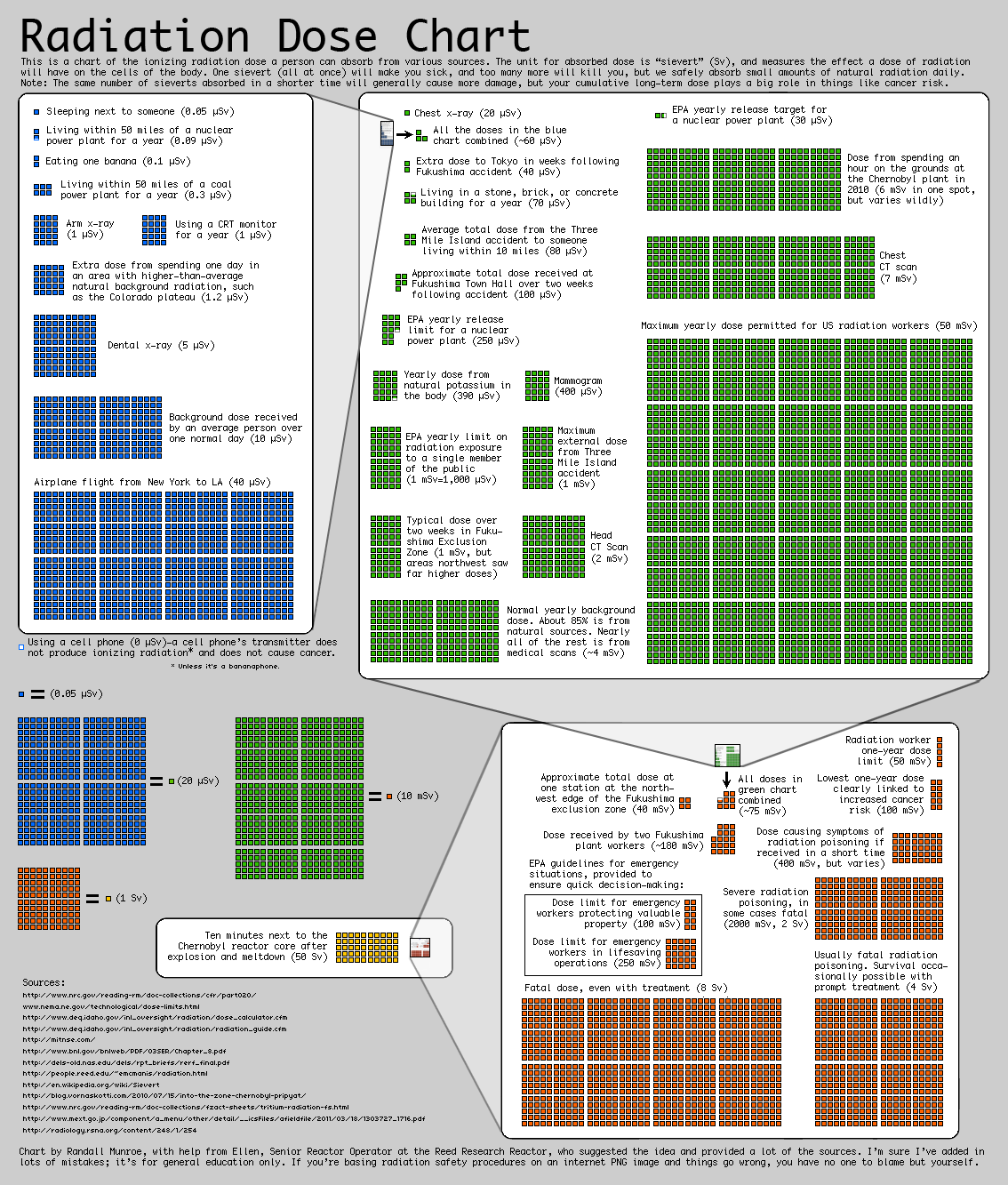
Also look at the radiation from a coal plant as shown in this diagram:

Radiation dose comparison from XKCD.com by Randall MunroeThe largest of the blue dose measures in the top left segment of the chart represents the radiation dose from just one airplane flight from LA to New York. The flying I did last year would have been enough to expose me to the dose received by Fukushima power workers.

Other of the blue squares represent the amounts flowing from the smoke stacks of coal burning electric power plants. We are frantic about tiny amounts of radiation exposure, that we are already receiving without being near any reactors.

We are panicking and frothing at the mouth about amounts of nuclear exposure that are tiny in their harmful effects compared to the smoke, and flames and environmental pollution that the rest of the tsunami and earthquake have produced.

If I had to choose between my family living downwind of a coal plant, oil refinery or nuclear plant it would be the nuke every time. If there is a forecast of a tidal wave or an earthquake - safest place to go? Your local nuclear plant.

If you dredge through the hype on Fukushima you don't see any actual figures on who was exposed to what. I have yet to see an actual report of anyone actually being harmed. Where are the workers whose rad-badges show them receiving an actual fatal or semi-fatal dose of radiation? Not one, and yet the death toll from the quake, the fires and other conditions flowing from the rest of the quake and tsunami are over 18,000 people.

What if you knew there was a power generation technology which killed in OECD countries between 1969 and 2000 a total of 14 people? Is the risk of that technology too great?

Do you say yes, 14 dead is 14 too many? Then you have consigned Hydro electric power generation to the scrap heap.

The same statistic for Nuclear power generation is zero.

For coal it is 2259 deaths.

So how has the international media got this so wrong? Apart from the hysteria and headline grabbing power of anything nuclear, the problem comes also from misunderstandings about the nature of radiation dose measurement.

There are reports of levels being measured at various locations, and spike rates being quoted as though they were constant - no actual figures of the workers (who wear dosimeters) of what they actually got exposed to.

I cannot believe how incredibly paternalistic our government and the USA are being. These demands to oversight what is happening in Japan verge on US Imperialism. And Kevin Rudd making demands on behalf of the "international community" to examine the reactors is just an outright challenge to a 1st world sovereign nation that would be warlike if it wasn't laughable.

This sort of thing happens all too often - you suddenly out of the blue hear Australian politicians and US politicians both spontaneously start singing off the same song sheet - its the intelligence briefings that they are all taking as gospel truth, even though military hawks with an eye on their budget are behind it. Same thing happened with Haneef.

In an article on this blog previously I wrote about how the same "think tanks" that denied the link between smoking cigarettes and lung cancer are now working to spread fear, uncertainty and doubt about climate change.

In Australia where there is no nuclear energy industry, its easy to forget how prevalent nuclear power is already. This represents competition, for the players in the energy sector - but what has kept nuclear down as a competitor to coal has been the cost of nuclear. Building a plant takes longer, and its approvals process is full of risks - especially for the investors in the plant. Once its built the operators of the plant must arrange to dispose of the waste - sequestration if you like - where as currently coal plant operators just spew their toxic waste directly into the air.

So what is interesting about this is that with climate change on the agenda, coal and oil industry executives are scared of a future where market dominance of their products is eroded by nuclear plants. The USA has a lot of Nuclear plants already, as shown in the map above - so does Europe, Japan and many other countries. It would be very easy to scale up nuclear plant building and scale down coal plant building & oil fired home heating (big in the north-eastern USA) if cap-and-trade or other anti-carbon measures made it economic. If coal plants were required to sequester their waste product like the nuclear industry has to, then their profits would be seriously eroded.

As a result these industry figures are cranking up their lobbying machine, and getting their PR executives and spin merchants on the job to peddle the anti-nuclear story to anyone that will listen. They're especially scared of advanced clean and safe reactor technology gaining a foothold since then their dirty and dangerous energy production will be unsaleable.

Here's a good analysis of the Fukushima situation by a British tech journalist. Summary - a 30 year old reactor, due for decommissioning, hit first by an earthquake at 9 on the Richter scale (when it was designed to cope with up to 8), and then hit by a tsunami - result no fatalities.

There are reports in the press of "people showing symptoms" but there is no science in any of this. If you have a population of thousands of scared people and ask them if they have symptoms X, Y and Z you will get a handful saying "Oh, I have that". There are zero medically or scientifically confirmed cases of serious harm radiation exposure to anyone outside the plant.

Its hard to find good data. Wikipedia has a lot of "data" on their Fukushima page but when you look at their sources, again all of the danger danger red showing on their tables is sourced from such august scientific sources as the Los Angeles Times or the New York Times, who are using words like "presumably" in their reporting

Compare all of this to the Gulf of Mexico and the BP Oil Disaster - that happened without an earthquake or a tsunami. Or Exxon Valdez.

Nuclear reactors are not killing or harming people. Just scaring them - or at least the newspapers are.

What is killing and harming people? Coal.

Coal pollutant contamination is what some people who do live near the dirty and dangerous coal plants already fear.

Thousands of people have died over the last 10 years from Athsma - and it is known that air pollution is a strong risk factor for those with athsma. Nuclear plants don't have any affect on athsmatics at all. If we replaced all of our coal plants with nuclear reactors tomorrow my bet is that those athsma deaths would drop significantly. Similar story with lung cancer and other health problems.

I believe we need to urgently act to stop the pollution from our current industrial and domestic activities. We only have one climate, we only have one environment. The worst offenders are coal plants, but the transport sector with its motor vehicles are up there too.

However our livelihood, our hospitals, schools and industries depend on energy - particularly electricity. If we are to clean up transport by switching to electric vehicles, that electricity has to be clean and sustainable. The base load power has to come from nuclear - nothing else is both clean and plentiful - wind and solar have their place, but you cannot run an aluminium smelter or a hospital or a data centre off wind and solar alone.

By fostering a safe and efficient nuclear industry now, the advances desperately needed in nuclear power generation technology can come from innovation. Thorium based reactors which we have known about for decades are now being built in China, and hold the promise of much safer, ubiquitous nuclear power with a tiny fraction of the waste.

If we falter on nuclear now, coal plants will continue and our climate and our health, and the world we leave to our children will suffer.

The writing is on the wall here - energy is dangerous. To be the safest we can be, nuclear energy is the answer.

Thursday, December 2, 2010

iMiev for Christmas

iMiev in city published with permission of MMAL
Well, I may have to take it all back - it just might be that Mitsubishi can deliver me an iMiev in 2010!

Today I spoke with Mark Whyte of Mitsubishi Motors Australia (MMAL), about the MMAL lease program and about the iMiev roll-out in Australia. True to his word, shortly after getting off the phone an MMAL lease agreement arrived in my inbox. Now I just have to see if we can put together the legals to make all this come together.

You have to hand it to Mitsubishi - they have consistently been delivering on the detail of their undertakings in the production roll-out of EV's in Australia, and on the phone I can see why - Whyte is pragmatic and straight-forward about the iMiev, for example talking about issues of range in Australian conditions.

Under that professionalism you can hear how pleased he (and MMAL) is about the success of the iMiev program so far. All of the cars that MMAL have been able to persuade their parent company in Japan to ship to our shores have been snapped up, even tho' this number was considerably more - 110 units now - than they had originally been earmarked for.

Now it will be up to the reaction of the early-adopting corporates that have signed up to lease the iMiev, to see how the program goes in 2011. Electric vehicles require a radical rethink - and for traditional fleet owners having EV's on the lot is a whole new ball game.

What do we do with that petrol card now? How will drivers of the fleet-owned vehicles handle plugging in?

For my part having been writing about EV's since 2007, the chance to finally have one will be a pretty big deal, and I can't see any problems at all with getting along with the iMiev.

Watch this space and I'll keep you updated on this development!

Sunday, November 21, 2010

2012


Floods.

Explosions.

Hell freezing over.

And, apparently electric cars in Australia.

Last week I rang Nissan Australia and spoke to one of their reps about when I could buy a Nissan Leaf EV. After all its prominently advertised on their Australian website, and nowhere there does it say that there are any delays in supplying the vehicle.

The context for this is that under the heading "Our Plan for Australia" BetterPlace, the demand side electricity-for-EV's technology supplier says they are "working with the Renault-Nissan Alliance, which will be among the first to introduce EVs". Of course to supply electricity for EV's to help us clean the air, and reduce dependence on foreign oil, Better Place actually needs the actual EV's that people will be driving. So when they say they are working with Renault-Nissan, you could be forgiven for thinking that when they "introduce EV's" that we will actually be able to drive them.

"Sorry", I was told by the Nissan rep, "not until 2012".

I also contacted Mitsubishi Motors Australia. Surely their iMiev, which is being trumpeted as the first EV in Australia is available? I personally think the iMiev is likely to be less car than the Leaf, but without the choice, I was willing to compromise. Here we are in 2010, the battle has been won, EV's are here right? Well, EV singular - the iMiev is here, at least, eveb if the Nissan Leaf is not.

As you would expect, there is enormous global demand for this vehicle, and consequently, availability of the i-MiEV will be somewhat restricted for a time. In response to strong demand from the local market however, Mitsubishi Motors Australia Limited (MMAL) has negotiated to secure a limited number of i-MiEV vehicles for Australian release.


Mitsubishi's rep went on to say that these cars are only being released to fleet buyers, and in 2011 they plan to release cars to the public. I will believe it when I see it.

Why?

Think about where are the cars that are being produced to satisfy this "global" demand going: Japan.

There is much evidence that the profits to be had in their home markets for Japanese EV makers are much greater counting in all factors including government incentives for clean vehicles that don't burn foreign oil.

Japanese auto consumers are also more tech-savvy, and more open to compact cars with advanced features. Why take the risk on markets like Australia, and the USA who are too dumb to even understand an electronic accelerator pedal. Hint: its not cosmic rays interacting with your pedal, its your foot.

However even tho' the manufacturers don't want to ship their cars here, they are not afraid of using their vapourware vehicles to hype their clean car image on their websites. All the while continuing to sell the gas guzzling, road hoggers that we follow the Americans in buying up by the ton.

A footnote about the Nissan Leaf promotional machine - I was contacted by phone by Nissan in October, and offered a chance to test drive the Nissan Leaf at the All-Energy Conference in Melbourne. Unfortunately I was just about to fly internationally for work, and could not take them up on their generous offer to pay all my own costs to appear in Melbourne with 2 days notice.

Had it not been for the international travel I would probably have taken them up on their offer - but it smacked to me of a failed PR effort, since I was aware that they had been running a competition on their website with very similar prospects. It made me wonder if perhaps they had not gotten a lot of entries.

Nissan, Mitsubishi, and others - wake up and smell the profits. People don't want flash websites and broken promises - we want the actual cars. We want clean air and better tomorrows.

And we don't want to have to wait until 2012.

Saturday, May 29, 2010

Th!nk Test Drive

From Th!nk Test Drive

I'm in Oslo, Norway at present and got an opportunity to test drive the wonderful Th!nk city car. This car is all electric - not a hybrid, using no fuel of any kind - and produces zero emissions.

Down at the Aker Brygge area - a redeveloped wharf district teaming with locals and tourists, numbers swelled by the Eurovision Song Contest being held here - a number of car vendors had their wares on display.

I spoke to Amelie of Rohneselmer who was standing next to a pair of Th!nk City cars - one red and one black, and was offered the chance for a test drive! Of course I said yes! A work colleague, who luckily knew the streets better than I came along for the ride.

Amelie took me to the nearby park and handed me the keys. Like any modern car, it had a remote for the rear hatch and for the doors. Also on there was a mysterious silver key that I was later to discover to be very useful.

The start sequence got me first time - unlike the Prius where you simply turn it on, the Th!nk has a traditional key-lock, and you turn it like a petrol car to a spring-loaded ignition position, until the car has powered up, then leave the key to return to the drive position.

After that bit of difficulty mastering the powerup sequence, I was off. The wharf area was chock full of twisty streets, cobbles and hazards, crossings and gotchas - the light, nimble Th!nk went exactly where I pointed it, and with no gear shift to worry about I was able to quickly negotiate my way onto some broader streets.

Here the cars pep really showed up the gas guzzlers, leaping away from the lights before the neighbouring BMW's and Vovlo's. Its smaller size meant that gaps were easy to take, plus a great turning circle, and very good visibility out the copious glass made me feel confident around the city streets.

Soon we found our way into a lot of small cobbled streets with sidewalk cafes, and families out enjoying the city. It felt great to roll down the window, and quietly and cleanly roll along with them, while smelly noisy gasoline cars really didn't seem to belong here.

Then out onto the civic streets again - where I wanted to try out charging. The test car only came with one charger - I suspect that any Th!nk owner would have a number. The stock one looks suitable for a garage and has a control unit that allows for stowing the cords around it, plus some controls and indicator lights. It looks as tho' it could either mount on a wall or lay on the floor.

After some early showers the weather had fined up, and the charging set up was quick and painless to set up. If you were going to be parked for some time, then an all weather charger would probably be needed. Other cars seemed to just have a plain cord that ran straight from the charging bollard to the cars socket.

The highway speed was something I did not get to try out, but Amelie tells me its good for highway speeds without any trouble.

The range question was asked. The current model had a sodium based battery, but newer cars are coming out with a Lithium-Ion battery chemistry and a claimed 160km range. These cars are just becoming available and are priced at 244,000KR, around $48,000 Australian dollars. This is the extra cost of the longer range batteries which come fully paid up - not a subscription or lease model of purchase.

However in Norway you have set against that purchase cost, a huge range of incentives thrown in by the local authorities - who despite being an oil producing nation are keen to see their cities clear of pollution.

As the driver of a Th!nk City EV in Oslo you get:
  • free parking in city and other parks
  • free charging at public charge points
  • reduced and free taxes, registration and charges
  • free travel on the ferries
  • toll roads, bridges and so on are free
  • use of bus, taxi and transit lanes
And of course you never have to pay for petrol ever again! Plus you're saving the planet and making the air easier to breathe.

As their logo has it "Green means go!".

I want one - maybe two!

Monday, March 15, 2010

The Prius Juggernaut

Final update:

The Toyota Prius stuck pedal is a hoax - its official now with multiple news sites reporting it:
...and many more.

Interestingly enough Steve Wozniak, co-founder of Apple has also owned up to his freaky stunt, saying that he too had been hoaxing, after being reported as having said his Prius had a stuck-accelerator.

Seems that TV reporters were all too keen to hear any story about Toyotas back then, and if you wanted to get on TV that was how to do it.

Further udpate:

This excellent video from edmunds.com - a US car review website - has a great demonstration of the all-weather car mat problem, and a very sane discussion of unintended acceleration.

If you really are interested in stopping so-called unintended acceleration then following the advice given in this video to put your car in neutral is the way to go.

For those that remain convinced that electronic gremlins in the fly-by-wire systems on cars is the cause, and that we should all go back to mechanical throttles because they were oh-so reliable I still await any evidence of this. The fact is that electronic throttles which cut out the engine when the brake is fully depressed, as the Prius does, are much safer than any mechanical linkage.


Update: a recent report of a collision with a wall after 56 year-old driver in New York state experiencing "unintended acceleration" in her Prius has been determined by the NHTSA to be a case of driver error. The NHTSA said
Information retrieved from the vehicle's onboard computer systems indicated there was no application of the brakes and the throttle was fully open.
What irritates me no end is that the original "breaking news" reports were stated in a way that conflated drive-by-wire with unintended acceleration. Now that the NHTSA have ruled it was driver error - the owner simply panicked and jumped on the wrong pedal - do you think there will be a breaking news retraction?

Meanwhile Prius has been rated the "Most Dependable Car" in a recent survey. But such stories don't compare for headline grabbing shock-horror value stories about out of control drive-by-wire that technophobes lap up with glee, even when they're proven to be completely bogus.

I'm on my third Prius. When an electric car becomes available here in Australia I'll buy that, but until then Prius is the lowest emissions option, with far better carbon footprint than any car in its class.

It's spacious - easily carrying 4-5 adults and baggage, has plenty of power, and an excellent standard of finish, and accessories.

When I got my first one - they were rare as hens teeth. I even joined a Prius car club. Seeing one on the road was cause for excitement. People at work marvelled at the LCD display, and the electronics under the hood.

Then over to the USA and my second Prius - they were a lot more popular there, especially so in California.

The image left is of that Prius, an 07 iTech with all the bells and whistles, sitting rather cheekily in the car park of the Tesla HQ in Silicon Valley.

Now in 2010 Prius is everywhere, even in backwater Brisbane, Australia. In my small work car park alone, there are 3-4; Prius taxis queue up behind each other in city cab ranks; and Prius drivers sail past each other on the roads without the slightest frisson of excitement or recognition.

It seems there is no stopping the juggernaut of Toyota's marvel car, as they struggle to keep up with demand, and win award after award with it.

Of course now that Prius is popular, that means a lot more people are driving them.

And guess what - that means idiots are also driving them.

Was just checking the news websites via Google news, and a number of mostly conservative news sites, like Fox news, are reporting a piece about the Police in San Diego helping a Prius driver with a stuck accelerator slow his vehicle. The piece was originated by the San Diego Tribune and syndicated by AP.

The article also comments that a Police officer was killed recently in a Toyota stuck accelerator incident, and that Toyota are involved in a recall at present.

These sorts of reports are often phrased in a way that to the casual reader sounds like all Toyota vehicles are death traps waiting to close around their next victim. The front page of the Economist has carried a recent story about Toyota slips up. Certainly seems like the world has got it in for Toyota.

Anyway - that "sudden acceleration".

Some additional facts are that the Police officer in that case was off duty, driving with his family; and the vehicle was a Toyota Lexus 4WD. The car also contained the driver's brother-in-law who phoned 911 during the incident.

The vehicle was a loaner car, while the driver's regular vehicle was being repaired. The fact that the vehicle was a loaner makes it more likely that the driver was unfamiliar with the engine on/off switch. There is no evidence that he attempted to put the car in neutral.

There was a recall last year for floor mats entrapping the accelerator pedal in some Toyotas - as far as I can tell this is what is being blamed for this 4 person fatal crash, in the preliminary reports.

The recall also involved packaging changes to instruct drivers in the proper installation of the all-weather floor mats which could slide forward if not fitted properly.

There is a Toyota current recall, but its only for some newer models, and relates to the braking of the car at very low speeds. Nothing to do with the accelerator.

There has to date been no investigation outcomes supporting any problems with the electronic throttle on Toyota vehicles as far as I know. However much of the hype out there is drumming up the notion that electronic throttles are to blame, and Prius electronics in general are faulty.

However Toyota have to manage possibilities, and also try to avoid problems that could make it easier for drivers to make errors. It has to manage perceptions, and if people experience things that they don't expect, and which could cause them to panic.

This is one of the reasons why our USA Prius had the EV switch removed - it was yet another thing that might "freak out" US drivers.

So.

I have been interested to discover what is behind all this publicity of stuck accelerator and failing brakes.

Any Police officer will tell you they are always suspicious of any reports made by drivers of vehicles, especially drivers who have been involved in collisions, or high-speed incidents. There can be some quite amazing behaviour and reports from drivers when they are on the face of it at fault in an collision; or when they suddenly notice that there is a "speed trap" and that they might have been detected by it.

I'm not saying at all that there are no valid reports - I'm just saying that reported incidents need to be carefully corroborated, using an evidence based approach.

In particular when serious incidents have occurred the cars are very very meticulously examined for mechanical and electronic/electrical faults by Police and Transport Authorities to determine if anything about the vehicle contributed to the collision. Where there is any corroboration at all from those examinations, or from examination of the scene and other eye-witnesses, then these reports need to be taken very seriously indeed.

A couple of other salient facts - there are a large number of lawsuits open at present for "Sudden Acceleration" - sites like http://suddenacceleration.com/ offer to find you good lawyers for your Sudden Acceleration Syndrome claim. This "Sudden Acceleration" syndrome has been around for 20 years now, and has become a nice little earner for lawyers.

If enough hype can be gathered about a particular vehicle, then there's plenty of instant whiplash victims donning their foam collars and ringing the local ambulance chasers to join the class action. For some this is better than working for a living apparently.

This wikipedia article is very interesting, and has a great history of the "sudden acceleration phenomena".

Basically after years of pursuing the Audi 5000 there was never any evidence for the claims of unintended acceleration - the class action lawsuit that was launched by several people reporting "Sudden Acceleration" was eventually lost after an expert who they called was involved with rigging an Audi to exhibit the fault for a television program.

The reports have been determined to be due to driver error such as hitting the accelerator pedal believing it to be the brake, or the pedal becoming stuck against some loose object in the footwell.

Note that in the case of the Audi there were recalls - to fit an accelerator pedal that was further away from the brake pedal. Its common apparently for sports cars to have the two close together for high-performance driving, but here the car was dumbed down for the american driver.

This article has a skeptical view of the Prius stuck accelerator reports.

My own view is that the vast number of these complaints are actually caused by cruise control. The reports in these incidents involve cruise control.

In this account:

I felt the vehicle [2008 Lexus ES 350] increasing in speed to about 90 mph, without depressing the accelerator. I had been on cruise control at about 73 mph... [A] passenger screamed at me to slow down. I was unable to do so, even after stepping forcefully on the brakes.

If the vehicle has been on a steady decline or level surface and encounters an incline, neighbouring vehicles not using cruise control will tend to slow down. However in a vehicle with the cruise control on, it will increase engine revs and in automatic cars drop to a lower gear.

A sudden call for extra power by the cruise control in this situation causes the motor to rev up quite dramatically. This should all be expected because you have asked the vehicle to maintain a high steady speed, and now on the incline much more power is required to acheive that. At the same time other vehicles in neighbouring lanes appear much slower by comparison.

If a driver has been at the wheel for a long time, in a steady stream of traffic, using cruise control, their alertness and attention to the road may wander. This is especially so if there are other distractions in the car. Suddenly the engine revs up, other vehicles out the window are going relatively slower - and a 10 km difference in speed versus the traffic will look like you are roaring along.

Now the driver who has had their feet away from the controls suddenly panics and tries to slow the vehicle - in this case it can be easy to misapply the controls, jamming the foot onto the accelerator, or getting both the brake and the accelerator.

I suspect a large number more of these reports are due to obstructions in the footwell of the car - like the improperly fitted floor mats in the Toyota cars. The remainder I would put down to driver error - fatigue, distraction and all the rest.

They go and jam their foot on the wrong pedal.

Whether its the cruise control thing, or footwell obstructions, putting the car in neutral and applying the brake always works.

There are I would say hundreds, thousands of drivers out there who have experienced problems from cruise control or footwell obstruction - they've put the vehicle in neutral and applied the brakes and all has been OK. However the ones who fail to control the vehicle - are they going to ever say there was something that they could have done? Nope, the damages - especially the more severe they are - are the fault of the vehicle manufacturer, the evil corporation.

The trouble with the litigious society is that it results in dumbing down of everything and poorer results for the rest of us that are able to drive and generally behave responsibly.

My view is that it is extremely unlikely that there are any valid actual incidents of something going wrong with the electronic throttle on any vehicles. You should start worrying about precautions for electronic throttles about the same time as you do for meteors falling on your head. The chance that that is true is far outweighed by the safety advantages of the electronic throttle, which for example automatically cuts out acceleration when you apply the brake (as mentioned in the allaboutprius article).

Here's yet another story about a woman who reported her Lexus going out of control. Her complaints were rejected by Toyota and also by the NHTSA - now here she is in a congressional hearing saying that the NHTSA aren't doing their job properly. The comments make for interesting reading.

I'm sure she experienced something horrible and frightening. However we need to get over the fact that not everything has to be someone else's fault.


Some more developments on the case of the "runaway Prius":

Turns out that
  • Toyota are stating that what he reports - that brakes were applied but the car kept accelerating - is not possible, and this was confirmed by tests both by Toyota and the NHTSA, while an observer from the congressional hearing was in attendance
  • The CHP - both the officer following the vehicle and the 911 operator - told him to put it in neutral over the course of the 27 minutes incident - he did not
  • Sikes, the driver of the Prius in the reported "sudden acceleration" case is a bankrupt, has a large debt, and has retained a lawyer
Commentators on blogs are comparing the thing to the "Balloon Boy" incident - where the news gets hold of something happening in "real time", but it turns out to be all faked.

Here is a guy who finds his car accelerating out of control, so he calls 911?? You're driving an out of control vehicle so you get on the phone?

But you don't try to put the vehicle in neutral, or press the engine off switch? You don't even have to move your hand from the wheel to put the car in neutral on the Prius - the stalk is right there on the dash.

I'm afraid my bullsh*t detector just tripped up into the red zone....

Saturday, February 6, 2010

Hot, Flat and Upgefscked


I hope the campaign is successful not just in shaming the coalition into action, but also in waking up our elected representatives; currently making a hash of their only marginally better policy on climate change.

The opposition keep name-calling, hoping that their slinging of the dread word "tax" will stick to Rudd's cap-and-trade policy.

The irony is that a tax would be the best policy of the lot - David Victor, Stanford University Professor and expert on international coal markets:

I think we have vastly oversold the role of the market in the solution to this problem...

As Dr Victor grudgingly admits, ETS schemes are failing and only a tax would be a strong and clear signal - fixed and away from the vagaries of the market, so that Australian clean technology entrepreneurs, as well as all other green innovations and measures are actually economically viable.

Why would you catch a clean green bus, when your car is cheap to run on petrol? Why would you pay much more for an electric vehicle, when your gas guzzler is so cheap to buy and register by comparison?

This is 2010 - the year of the electric car, but we won't see any of them in numbers Australia because our governments are completely failing to create policies to make it attractive to manufacturers to ship them here. In the UK tax on new cars is figured based on their emissions ratings and thus EV's are very attractive there - zero emissions vehicles finally competing on a level playing field. In the USA tax credits are available for zero emissions vehicles - for example resulting in a $7500 saving on the Chevy Volt.

Why are electric vehicle entrepreneurs in Australia struggling to get off the ground?

Because here we just dig stuff out of the ground and ship it over seas. That's what we do, that's our plan for the future.

The Smart State? The lucky country? Nope, we're the Idiocracy. If it wasn't bad enough that we have Senator Fielding, Communications Minister Stephen Conroy and Attorney-General Michael Atkinson. Now we have Abbot and his ludicrous non-policy.

The problem for Australia with regards to climate change is that we've completely failed to realize the urgency, and the Abbott's of this nation are just lowering the average climate intelligence quotient right across Australia.

The heatwave conditions in Feb 2009 which filled the morgue in Victoria and spread wildfires were the pre-saging of more to come, according to the Australian Bureau of Meterology, thanks to climate change.

But more heatwaves when they come will not be our biggest problem here in Australia.

I've just read (on pg 80 of) Thomas L Friedman's "Hot, Flat & Crowded" (2009 edition) that the Sigma Xi group, commissioned by the UN to report on climate change, said in their February 2007 document "Confronting Climate Change" that the relatively small increase of 0.8 degrees C since 1750 has been "accompanied by significant increases in the incidence of floods, droughts, heat waves and wildfires".

But more fires and droughts when they come will not be our biggest problem here in Australia either.

Our bigger problem is that when the effects of climate change hit the countries most vulnerable to its effects, when their crops fail and disease spreads and generally things are looking like the four horsemen of the apocalypse have moved in for good: where do you think those refugees are going to go?

Here is where they'll go: the lucky country. While we battle bushfires, and raging ignorance, and compete to see how far we can stick our heads in the sand, desperate refugees will be arriving here in force. At the same time, our armed forces will be called on for international relief efforts, much as they were for the tsunami disaster in Banda Aceh in 2004.

While we turn up our air-conditioners, and argue that climate change is bogus because of some emails from East Anglia, the evidence of climate change will be arriving on our doorstep in ever-increasing numbers.

Oh, and Tony, good luck reanimating some the policies of our old dark lords with a return to "turn back the boats" policies - these people will have no country to go back to.

Apart from refugees, the other problem dwarfing fires, drought and heat that climate change will bring for Australia is that if we keep being as backward as we are regarding clean technologies is that soon no-one will want the stuff we're digging out of the ground.

China is investing massively in clean technologies, and indeed some of our top talent in solar technologies have gone there - others to the USA - due to the clear state commitment to controlling climate change with high-tech solutions, especially compared to the dismal picture here.

When these large Chinese plants come on line in the next 5 to 10 years their own local reserves of coal will be more than adequate to meet the needs of their dwindling coal plants.

By then it will be too late for Australia to turn around and beg those scientists to come back and start trying to foster a clean tech industry - we'll be sitting on a pile of worthless black dirt that no-one wants, and lagging so far behind the technology race that we don't have a hope of catching up.

Swamped with refugees and becoming a backward third-world country. That's not what I want for my Australia.

Come on K Rudd - show Abbot what a real forward thinking climate policy looks like, and make us the lucky country once again.

Sunday, November 22, 2009

The Future of Energy

In a very timely conjunction, I went to a great panel discusssion of five experts, all of whom were speakers at the Australian Academy of Technological Sciences and Engineering 32nd Symposium held just recently in Brisbane. The title of the symposium was Future-Proofing Australia - Rising to the Challenge of Climate Change.

I say timely because the panel discussion was a face-to-face demonstration of a real conviction in the scientific and engineering community that ways are immediately available to move forward into cleaner energy for Australia.

Perhaps for me one of the most surprising moments in the proceedings were when a straw poll was taken of the audience on whether they would support nuclear power generation in Australia: the result was a resounding "yes".

Myself I'm used to being in the minority especially amongst my greenier friends when I advocate for nuclear power.

After the event I talked to one of the panelists, Peter Meurs, about his Blade EV which Peter charges from a very impressive solar array at his home. A real world example of zero emissions EV driving.

Of course if you have read my previous posts, a future of greener power generation has great implications in electric vehicles. If EV's have only relatively small takeup - and optimistic projections say 20% by 2030, then the impact on the grids emissions will likely be negligible.

But with clean power we can look to a future with close to 100% EV penetration in the national fleet - with all the zero tailpipe emissions that that would entail - without having a coincident increase in emissions from coal fired power plants.

Why this is critical is that many EV manufacturers are only going to deliver their limited EV production to countries that provide decent governmental support, with infrastructure spending if possible, but also with taxes or other incentives that make the EV's competitive with petrol powered cars. And governments will do that if they know that EV's will definitely reduce greenhouse gases.

While at the panel discussion I also spoke to another of the experts, John Loughhead of the UK Energy Research Center, who told me about the UK system of incentives and programmes for low-emissions vehicles in the UK. John told me about the UK excise on vehicles that have higher emissions of greenhouse gases, which as an example usage of the VED calculator places a duty of 405GBP (around $730 Australian) on the 4.2l V8 Ranger Rover for its 376 g/km.

When vehicle buyers are paying for their polluting ICE vehicles at a rate that reflects their actual cost to the environment it makes the extra upfront costs of zero emission EV's and low emissions PHEV's comparable on a level playing field.

The aim of the long tailpipe crowd is to spread confusion and disinformation in order to derail that message and kill off the electric car by making ICE's stay at their artificially cheap current day prices.

I'm seeing a lot of activity around the "long tailpipe" issue at present. Of course there is the E&T report which I critiqued in my last post, and before that the GAO report in June. I dismissed that report at the time as it made no negative findings about EV's.

However it was quoted in a number of articles since under headlines like "GAO: Electric Cars Won't Reduce Carbon Emissions". This is a bit of a stretch from what the report actually says which is that electric vehicles charged from coal fired power will only be 4-5% better.

Update: I contacted Mark Gaffigan (Director of the Natural Resources and Environment Team at the GAO, and lead author of the report) for comment:
The bottom line regarding your questions, per our report, is that plug in electric vehicles could result in reduced emissions of greenhouse gas emissions and air pollutants but the environmental benefits depend upon whether the electricity used to power plug ins emits fewer greenhouse gases and pollutants than the fuel it replaces.
What Mr Gaffigan is carefully saying is that EV's could result in reduced emissions - not that they definitely won't - and that whether they do or not depends on the grid.

I am at a loss to understand the cynicism of attacks on the EV, which wilfully misquote reports and studies, and use other dirty tricks.

Do these people really believe that we can just keep driving in petrol powered cars?

We should have fixed this 30 years ago when the first oil shock occurred, when we realised the dangers of being hooked on oil and beholden to its curators, a who's who of enemies of reason and western democracy.

Here is some good science that provides yet another example of how personal management of EV charging provides the opportunity for great reductions in greenhouse gas emissions. There is no such opportunity with petrol powered cars, including conventional hybrids.

Its great to see some real science and engineering working on getting solution that work now rolled out for the benefit of all our futures.


Sunday, November 15, 2009

EVs Speed Climate Change? WTF??


Now that climate change is firmly on every country's agenda, lobby groups and think tanks everywhere are jumping on the band-wagon.

It seems like there are million of these wise-ass organizations trumpeting green advice for public consumption, and producing policy statements and reports for government.

A very common factor in many of these statements and reports is the well-to-wheel analysis which talks about electric vehicles producing greenhouse gases. Below I go into a detailed discussion of why this type of analysis and its conclusion (EV's produce greenhouse gases) are just plain wrong.

But first a prime example of how misleading this type of "report" can be.

Clean vehicle website Autoblog green is carrying a press release from the Environmental Transport Association, quoting from a new report by a group called Transport & Environment stating that:
Switching to electric cars could speed climate change
There are other groups such as the National Resources Defense Council and the Environmental Law and Policy Center saying:
Wait!! Oh, my God!!

You mean my electric car, which I thought was definitely clean and green, could actually bring on climate change? Panic! Hold the presses!!

Could, might? Its lurking down there in my garage, and on the toss of a coin, the roll of a dice, it might decide to start spewing greenhouse gases into the environment! There's a chance??

No?

So what the hell are they talking about then?

Are these guys some sort of oil industry goons, talking down EV's?

No, they're mostly not - but they're also not scientists (like the IPCC) or governmental agencies (like the US Department of Energy). They have their own particular hobby-horses to ride.

The ETA for example is a company that makes its living in the United Kingdom by selling green transport services, like insurance and roadside assistance. Its name - Environmental Transport Association makes it sound official, but its a commercial organisation, and it has to pay the rent just like any commercial organisation. Every EV owner who believes that their vehicle generates no emissions is one less customer for ETA's carbon offset service.

NRDC does not like coal, and - rightly so - is keen to jump on any chance to point out that increasing dependence on electricity in states that depend on coal has to be coupled with a corresponding commitment to reducing the use of coal in its power generation mix. As the NRDC rightly points out so-called carbon capture and sequestration is not a "technology" it is a branch of science fiction, and is not to be relied apon to clean up coal-fired power generation.

And of course since most of the states in the mid-west rely on coal for power generation (see table A1 in the DOE's figures), the ELPC (a mid-west specific environmental organisation) is keen to see that the new-found governmental interest in EV's does not push aside concerns about pollution from coal fired power generation.

There is a completely valid point to be made here that coal fired power generation is an environmental hazard, and that clean power generation has to be a top priority in the fight against climate change.

What is not valid is to connect uptake of EV's to an increase in coal fired power generation.


See the could here, is not that there is some chance or possibility. Green EV's are not suddenly going to start producing greenhouse gases on some percentage outcome.

Electric Vehicles never ever produce greenhouse gases.

All of this confusing scare mongering is just another repackaging of the good old long tailpipe argument that we've heard so many times before.

Let me just say this again slowly.

Some power plants produce greenhouse gases. Not EV's - power plants.

An EV is not a power plant, and EV's don't have tail pipes at all, or chimneys, or in fact any way at all to produce smoke or pollution.

Well-to-wheels - in depth discussion

How this mischief has come about is that the good ol' boys that we love for coming up with the "Hummer is more economical than the Prius" and other great "analyses" and "reports", just could not except that EV's produced no pollutants. They said "You have to look at the big picture - you have to do a well-to-wheel analysis".

As a result the EPA and also european equivalent organizations have come up with measures based on gCO2e - which means in English grams of CO2 equivalent, used to analyse things like the total impact of renewable fuels. Stretch that analysis over vehicles and you have gCO2e/km, which results in completely bizarre statements like the GM claim of 230 miles per gallon for the Volt PHEV.

Don't get me wrong - the Volt is a great design and will be a great vehicle for reducing greenhouse gas emissions. But 230mpg is rubbish - its meaningless. Why? Because equivalents just do not work when you start powering vehicles with electricity.

How you drive, when you drive, when you charge, how you charge - all of these things are drastic game changers for the sums behind the report that the ETA is quoting from.

I contacted the ETA's press officer and on request was promptly given a copy of the 51 page report. The report is actually written not by the ETA, but by the European Federation for Transport and Environment. Yet another official sounding group, T&E is actually an industry organisation representing around 50 different bodies mostly with a environmental focus. The report is not new facts - it is an analysis of existing studies and of yet more reports. The main focus of the report is on the European Emissions Trading Scheme and the impact of European government taxation schemes on electricity generation for EVs.

The T&E group wants stronger government action to tighten taxes and legislative incentives to produce cleaner power - something we all should wholeheartedly support. But since EV's are so high on the agenda of governments, T&E is hitching their message about cleaner power to EV's by saying EV's could "produce more emissions" unless power is cleaned up first.

This is where T&E stretches the friendship, by making claims that there is no science to support.

So what does T&E base its claim on, if its so wrong?

Well, the sound bite that heads up ETA's press release, and which is trumpeted in the introduction to T&E's report is referenced (on pg 27) to a study by Kromer & Heywood. In fact several large portions of the T&E report are verbatim from Kromer & Heywood's study.

Take note before going on, that the plugins could speed climate change statement has actually lost some context as it appears in the sound bite: the Kromer study is actually saying that if power is coming from coal, PHEV's like the Chevy Volt will be marginally more emissive than a hybrid vehicle like the Prius.

I think you'll agree that this is far from saying that EV's will increase climate change, but its still wrong, and its potential for misquoting means that it must not be left to stand.

The Kromer study was funded by companies including Shell, and the Ford Motor company. The latter via yet another research group called the Alliance for Global Sustainability. It is wonderful that Shell and Ford are getting involved in funding research into sustainability, and not for a minute do I suggest anything but the highest standard of intellectual rigour in the methods of Kromer's study but again it is not new science. The methodology is to take existing figures and using a computer model develop a number of scenarios to predict future figures.

All of these scenarios are based on the idea that CO2 equivalents can be fairly calculated for the electricity used to charge EV's. In fact the methodology uses a straight energy content calculation, and goes further by doing such things as adjusting to allow for transmission losses via the grid, comparing these to the plant-to-tank costs for transporting conventional fuels.

These foundation assumptions for the well-to-wheel (WTW) methodology employed are just plain wrong. WTW is the long tailpipe argument in academic guise. The methodology comes from an existing energy sector that is clinging to its existing structure with oil refineries as central points of distribution.

But notice that while no company, save the oil companies, can currently refine their own petroleum to drive their cars, everyone has the potential to generate their own power to power EV's.

This is the first breakdown in the WTW assumption. Electric grids world wide are right now being transformed by local power generation from a vast number of solar panel installations. Solar panels are going on rooftops all over the world.

While I was working at Google last year, the many electric vehicles on the campus were being charged from the solar array on the Google rooftop. Here in Australia houses all over are sporting solar rooftops thanks to the governments incentives.

There are zero transmission losses here - the power is generated right where it is used, and that power is 100% clean.

Oh, but wait - those amounts of power are still tiny compared with total electricity consumption!

Yes - but so are the amounts of power being used by electric vehicles! EV's require very small amounts of power to run, and we have so few EV's that the process of renovation of the grid is more than keeping pace with EV uptake.

While many of these environmental reports are talking about "technologies" such as carbon capture which are right now just science fiction, EV's and local power generation is here and now. Its already working.

Along with local power generation from solar panels, there is also a large amount of activity in co-generation, demand side response and active power market participation.

When I was at the AEVA Electric Vehicle Festival in October I met and talked with Dean Spaccavento, Enabling Technology Manager with Energy Response. Their service involves enabling companies to take an active part in the National Energy Market, by responding to energy demand as reflected in real-time updates of energy costs via DSR. The software and hardware systems that Dean is involved in building go into Australian industries and reduces their total energy bill, whilst at the same time reducing the impact on total energy generation capacity requirements and the environment.

Companies that produce energy as a by-product of their operations can generate electricity on site, to both provide their onsite electricity requirements, and also sell back into the grid. There are a increasing number of co-generation sites in Australia right now, such as Coopers Brewery in South Australia. Power companies are getting into the act, enabling and welcoming co-generation as a way to reduce load on power generation capacity and also reduce environmental impact. Using software like that produced by Dean Spaccavento's company they can benefit financially by responding to the local market with their co-generation capacity.

This is working, right here, right now. Zero transmission losses with power being used on site, and with EV's in that companies fleet parking lot their charging is not reflected at all in any central coal fired power station.

The future for co-generation has much greater promise, with waste products being used for domestic level power generation instead of going into landfill. South Australian company Micro-Cogen have developed a small scale cogen unit suitable for the basement of your house which they say will be shipping in 2010.

Smart grid technologies also have matured and will form an integral part of the EV take-up phenomenon. As we see our grid as mentioned above becoming cleaner, it will also become smarter with software and hardware from a whole range of companies, including industry giants IBM, and other new startups competing to provide the best savings in electricity generation capacity.

EV's are inextricably bound up with this future since they are ideally situated to be charged at times when it is cheapest for their owners, and also lowest impact on the grids generation capacity.

When the dinosaurs of the energy world, the oil companies threw up their hands in horror at being compared to EV's they were right to be afraid. Their well-to-wheel analysis tries to portray a negative impact via the long tailpipe argument for EV's on the basis that a "whole lifecycle" model is the only fair way to compare EV's with internal combustion engines (ICE's).

But we have had 100 years of internal combustion engines, and now the landscape is covered with petrol stations, pipelines and petrol tankers - the infrastructure to support the plant-to-tank mentality that the dinosaurs are still clinging to.

The only fair way to compare EV's to ICE's is to look at what the energy distribution network will look like with these real current technologies - smart grids, solar, co-gen and local power generation - feeding into the EV picture.

Forget about gCO2 equivalents which assume the moment you plug your EV into the wall, a power station somewhere is instantly going to produce smoke directly in proportion to the energy used at the socket.

Those analyses were bogus when the oil companies first proposed them, and they are bogus now, even though many producers of reports who ought to know better have swallowed their marketing story.

But surely all these smart grids and co-generation are going to take time to ramp up, and in the meantime if every body goes out and buys EV's isn't that going to put pressure on the existing electrical grid causing more pollution from coal fired power stations?

But the reality is EV uptake is going to be slow. It will take years for early adopters to convince the middle of the normal curve that a switch to an EV is a good idea. Even with Nissan producing its new Leaf EV in production volumes next year, going forward EV's as a percentage of the national fleet will by even the most optimistic of projections still be down at %15 by 2030.

And the good news is that our existing grid infrastructure can easily accommodate the loads generated by these levels of demand without generating any new pollution at all. The charging can be done out of surplus capacity, meaning that even in places where coal is being used for generation, no extra generation will be done as a result of the EV's plugging in.

A study in 2007 by the Pacific National Northwest Laboratory found that surplus generation capacity in the USA could support 43% market penetration of electric vehicles, based on charging being done during the night. Interestingly this same information is actually quoted by Kromer, and Kromers quote is produced verbatim in T&E's report, yet they both fail to draw the obvious conclusion that projected levels of EV uptake are not going to have an impact on power generation. The PNNL report mentions a case study of San Diego where night time charging would allow up to 60% of the San Diegan's becoming EV drivers before any generation impact was felt.

Of course the T&E report claims (page 30 and 31) that as EV ownership increases, quick-recharging facilities are demanded and
"...substantial daytime charging will also occur..."
however they offer no support whatsoever for the claim of substantial daytime charging. Whereas the PNNL study examines night time charging as the obvious mode, there is no support in any actual studies for T&E's claim.

Does it make sense then? Will people charge during the day rather than at night?

You can only charge a battery if it is empty, or partly empty. And EV's are always plugging in where-ever they go. You arrive home from work in the evening, plug into the wall socket, and during the night the battery is topped up to full on cheap night-time rates.

Then during the day you head out to work, and maybe your employer has a charge point to plug into. If you're an EV owner you definitely have a charge point at home, but maybe your employer has one for the EV owners on staff. Then on the way home you stop at the supermarket for 30 minutes, and maybe there is a charge point in their car park.

And of course since the majority of drivers make relatively short trips, their EV's are going to be nowhere near empty when they plug in during the day.

Also day time charge points are going to be supplied by a company like Better Place, and will involve a charge via your credit card. Even if its like iTunes, where you make micro-payments for the small amounts of electricity topped up into your EV's its going to be much more attractive for most consumers to get their power from the socket at home where it just appears on their power bill. Or doesn't appear, if they have a solar panel or co-gen.

So these day time charges are going to happen, but due to:
  • cheaper night time rates
  • ubiquity of home chargers
  • slower rollout of charging points at other locations
  • small trips by driving majority meaning day time battery levels are high
  • charging account costs with daytime power compared to home charging
all meaning that the claim that daytime charging is going to be substantial does not make sense.

I am sure daytime charging at Better Place style charge points will be a very important part of the EV landscape, especially when EV ownership levels are as high as 20%, but even then daytime charging will not represent a substantial amount of kilowatt/hours put into EV batteries.

Instead daytime charging will be a part of the modality of EV usage, that you top up in small amounts so that you never have to worry about being low on juice.

Conclusions - EV's (still) do not "produce" greenhouse gases

Current levels of EV usage do not impact at all on coal fired power generation, and so EV's being charged today, are thus not generating any additional greenhouse gases.

By the time the EV landscape has progressed to 30% ownership, for the range of reasons discussed above, power generation will have changed how electricity delivery takes place to the point that EVs will still not require any additional power generation from coal fired or other centralised power generation sources associated with greenhouse gases.