Wednesday, August 3, 2016

My Studio Hits the Big Time

Lately all my time has been devoted to Game Development and setting up Smithsoft.

Since January 2016 with Space-Bot Alpha behind me, I expanded the studio and bet the farm on a new game Pandora's Books.

It's a game about Pandora who opens the wrong book and releases the chaos wizard & his minions onto the worlds of classic stories.  As a player your job is to unscrambled the mixed up words, to defeat the wizard & his minions, and save the cities of these timeless tales.  The game ships with War of the Worlds unlocked and as you play you collect clues that can be used to help when you're stuck on a word, and also saved up to unlock books.


The team has been amazing, and last week we pushed the game to Apple's App Store editorial team in the hope of getting a feature!  This is the "big time" for me, and I guess even if we don't get the much-vaunted Apple feature we still have a great game which will go live on August 18th.

If you want to follow my journey as an Indie Game Developer check my dev blog for more details.

Friday, April 19, 2013

The Next Electric Cars

We've had over a century of development on fossil-fuel powered vehicles.  It was a time when the requirements of motorists and the romance and passion of motorsport combined to produce improvements in cars that were about sensible things such as economy and ride quality; but also the things that get petrol heads out of their seats like top speed performance, handling and acceleration.  It was a time when cars went from being expensive, dangerous and noisy rattle-trap playthings for the rich, to being fast and practical transport for the many.
The 1915 Detroit Electric

During that time sadly virtually no progress was made on a automotive propulsion batteries or electric vehicle motive power.  The Electric Vehicle arrived on the scene around the same time as the Internal Combustion power car, and while the EV was supreme in the cities, through accidents of history and industrial conspiracy which you can read about in Edwin Black's "Internal Combustion" the EV passed into the annals of history.

Electric Citicar - Southward Auto Museum, New Zealand

Technologists and even motor companies dabbled in electric vehicles during that 100 years, but saw them as toys and quirky golf-cart size "personal transports", like this "Electric Citicar" made between 1972 & 1978 by Sebring-Vanguard.  Really these sorts of vehicles were new bodies on the old technologies no better than the lead-acid batteries of the Detroit Electric 60 years previous.  They were light-weight experiments instead of real full-blown motor cars.  So called electric "neighbourhood cars" still produced today are still evidence of this lack of progress.

Until now.

Photo of the Porsche 918 from GizMag
The 2013 Porsche 918R Hybrid 770bhp 3s 0-60 (gizmag.com)
Now with crises in air quality in our big cities, the effects of global warming and pollution in general on our planet, and the need for energy security we are seeing a resurgence in electric vehicle technology, and electric vehicles on the production lines of many of the world auto makers.

We are also seeing high-performance vehicles powered by electric motors on our race tracks.  Vehicles like the incredible Porsche 918 Hybrid.  While it does have a petrol power-plant on board as well, the 918 can run on pure battery power, and with advances in batteries (see below) Porsches technology will no doubt be seen in future all electric vehicles.  The point is that the electric power train is already seen by high-performance motor engineers as the way forward.

I drive a Nissan Leaf: a practical all electric passenger sedan with a range of 175km and performance equal to or better than similar sized fossil-fuel powered cars.  The Leaf has no exhaust pipe and produces zero emissions, so as I drive past schools and sidewalk cafes I can be sure I'm not ruining the air quality for my fellow city dwellers.  I don't have to make a regular pilgrimage to buy fuel at gas stations, and any time I go down to the car in my garage its there ready to go, charged up for free courtesy of the solar panels on my roof.  Its a clean machine.

But electric vehicle development is not stopping there, and its interesting to wonder how far behind we are after our 100 year sleep, and how quickly we can catch up.  Look at the speed of the cellphone revolution for examples of the speed of innovation we can expect.

There are a couple of things to be said about this catchup process - first is that electric cars while already good, they are only going to get better.

Motor-sports aficionados already recognise the applicability of the new technologies in EV and hybrid power, so we are seeing a new age where the petrol-head becomes the electron-head, as speed and handling come from improvements in electronic and electric drive technology.

One example is the active steering and suspension on the Porsche which has many new freedoms for designers of high-performance cars due to the flexibility electric drive gives you.  The old CV joint and half-shaft, or conventional differential and driveshaft setup of petrol powered vehicles meant many restrictions on what can be achieved.  Porsche engineers are breaking out of these paradigms with the 918 and setting new performance benchmarks as they do so.

exploded image of in wheel motor and tyre
Protean in wheel motor (cleantechnica.com)

In wheel motors promise huge advances in this area, effectively giving 3 degrees of freedom for suspension geometry design and active (computer controlled electronic) suspension and drive systems.  Protean claim also much improved regenerative braking energy recovery.  While in-wheel motors have a challenge with unsprung weight that is outweighed many times over by the prospects for fully active suspension, steering and drive that comes from an in wheel motor.

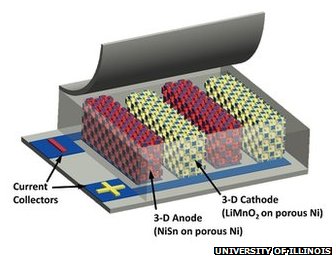
graphic interpretation of the micro battery architecture with tiny interleaved cells
University of Illinois interdigitated battery architecture (BBC)

This new battery technology unveiled just days before I write this article comes from the University of Illinois and promises power outputs 10s or 100s of times better than current battery technology.

Update: (thanks Russell!) it was pointed out that the U of Illinois battery is more about power output than watts per size (energy density, or capacity).  Other projects are promising big improvements in EV range from higher battery capacity, such as the 3 x lithium-air chemistry and 10 x aluminium-air projects, like the one from Phinergy (although the latter one is currently not rechargeable).

With that sort of energy density my Nissan Leaf would have over 1000km of range on a battery half the size of the one it currently has.  Countries that want to improve air quality in their cities while keeping up with the bleeding edge of technology in transportation are investing heavily in the R&D of battery technologies.

Fossil-fuel powered cars will still be around for a long time, but their golden age has past now.  No matter how good you make internal combustion engines, they rely on foreign oil and produce pollution.  Yes, there are ethanol and other bio-fuels now, but in practice you have to buy E10 or other mixes with petrol.  In theory diesels and flex-fuels can use 100% bio-fuels, but its not available now and production in quantity appears to be neither economically viable or environmentally sustainable.

Advances in internal combustion powered vehicles show fewer and fewer returns for R&D dollars spent, compared to electric.  There's no flux capacitor or magic catalyst that is going to improve petrol 10s or 100s of times over.  ICE cars are about as good as they can ever be and no promised fuel technologies are coming to change that.

I'm driving my 100% emissions free sun-powered electric vehicle today.  Right now.  No theories, no corn subsidies, all real.

Now the point of all this is that the way ahead for Electric Vehicles is expanding and full of promise.  Every new advance brings large improvements in practical areas like range, and carrying capacity.  When EV's are powered by clean sources like my solar panels the entire personal transport experience is of low impact to our environment.

How far can the Electric Vehicle go?  I'm excited to find out.

Saturday, July 21, 2012

Post-normal Science?


Recently the Liberal-National Party came out again in favour of teaching Climate Denialism in schools, and I wrote in Google plus about how this policy came directly from the Heartland Institute - a USA neocon policy institute.  LNP declared that climate science is "post-normal science" and thus should not be counted as real science.

Huh?  There's a new science?  What does "post normal" even mean?

This bogus tag of "post-normal" has been constructed from incoherent ramblings in the name of philosophy of science by writers including Jerome Ravetz, whose writing can be seen on notorious climate denialist blog "Watts Up With That".  According to Watts, vociferous climate denier, author of the blog, and recipient of funding from the Heartland Institutes coffers, Ravetz is an honoured guest.  Wonder what I mean by incoherent?  See if you can make any sense out of the gibberish at the post normal science blog referred to in the Watts article.  It reads like the worst excesses of post-modernist philosophy, or like something from computer generated post-modernist satire the Da-Da engine.  (hint: if you go to that link, refresh the page and each time you'll get a nonsensical pile of computer generated post-modern drivel).  Here's a sample of post-modern as generated by the dada engine:

1. Stone and conceptual socialism
“Society is dead,” says Sartre; however, according to Brophy[1] , it is not so much society that is dead, but rather the meaninglessness, and some would say the rubicon, of society. Several narratives concerning precapitalist theory exist. The characteristic theme of Cameron’s[2] analysis of dialectic narrative is a posttextual whole. Therefore, Sontag uses the term ‘postsemiotic Marxism’ to denote the difference between class and sexual identity. The main theme of the works of Stone is the role of the observer as writer. If one examines precapitalist theory, one is faced with a choice: either accept Batailleist `powerful communication’ or conclude that language may be used to exploit minorities, given that the premise of dialectic precultural theory is invalid. Thus, the subject is contextualised into a conceptualist theory that includes truth as a totality. Baudrillard uses the term ‘precapitalist theory’ to denote the fatal flaw, and therefore the absurdity, of subdialectic culture.
Just to make it crystal clear - that quoted paragraph was not written by a human - it was generated by a computer algorithm programmed to produce crazy.  And here is Ravetz explaining post-normal science:

1. Introduction
Post-Normal Science (PNS) is a new conception of the management of complex science-related issues.  It focuses on aspects of problem solving that tend to be neglected in traditional accounts of scientific practice: uncertainty, value loading, and a plurality of legitimate perspectives.  PNS considers these elements as integral to science. By their inclusion in the framing of complex issues, PNS is able to provide a  coherent framework for an extended participation in decision-making, based on the new tasks of quality assurance.  The shift to a post-normal mode is a critical change. The approach used by normal science to manage complex social and biophysical systems as if the were simple scientific exercises has  brought us to our present mixture of intellectual triumph and socio-ecological peril.
Notice a similarity?  :-)

I'm being a bit tongue-in-cheek here, but the sort of stuff that Ravetz is on about is exactly what the programmers who built the dada engine were satirising.

So what is Ravetz on about then?

Its origins are in the media storm about emails published from the Climate Research Unit in East Anglia, England.  There's not room to go into it here, but a massive archive of emails and other material were published by a journalist, and items cherry-picked from it purported to show ill-intent and unethical conduct on the part of climate scientists there.  In the event there was no smoking gun, no-one owned up to stealing the emails from CRU, and  the CRU scientists were shown to be innocent of the claims.

However during the fracas the likes of Ravetz turned up claiming (in his almost inaccessible prose) that the CRU emails meant that scientists must all open up everything they do, and in particular that unqualified people should be able to get in on the peer review process - Hulme, the co-author is a climate scientist at CRU, and author of the book Why We Disagree About Climate Science.  It reached a huge audience when published in a much referenced article by the BBC.  So how is that the denialists are fete-ing Ravetz as a champion of their cause, when he was launched to fame at the side of a prominent climate scientist?

When the issue with climate change became urgent enough for governments to see that action was needed they called on a dream-team of their best scientists in the field to report on what could be done about it.  Not hearing the danger music of the trap that was waiting for them the scientists did their job, produced the facts and summed it up in the IPCC reports.

The problem is that scientists are no good at politics, and they are not PR experts.  Hulme saw that the opponents of action on pollution and climate change would do anything - including stealing and cherry-picking their private email communications - to impugn the reputation of the scientists, and try to undermine their work.  Maybe Hulme thought that democratizing science would mean that less heat would come on scientists themselves for unpopular conclusions.

This confusing blog article discusses the idea further in classic post-normal science prose, so difficult to follow that its not easy to determine whose viewpoint it supports, who its author is, or what claims it is actually making.  In my view the idea of post-normal science is ridiculous and I can't imagine anyone in their right mind seriously promoting it as a way to better obtain scientific knowledge.

Regardless of what these proponents of PNT are actually saying, the way you actually obtain scientific knowledge is for scientists in research centers and laboratories to do work, collect data, analyse it and present their findings in peer-reviewed journals of high-standing.  Those scientists share their data with their peers, and discuss their methods to allow verification and replication of their results.

Allowing in amateurs, commentators and provocateurs is not democracry.  You don't vote for the truth.  Science is not a committee decision.  Also it allows for the likes of Stephen McIntyre on of climateaudit.org who demands scientific data from researchers so that he can go hunting for anything that supports his denialist agenda.  Note that word "audit" - a key idea from the post-normal manifesto.

So is post-normal science good or bad then?

That is like asking are vampires or witches good or bad.  Post-normal science is a fiction.  There are no post-normal scientists.  There are only commentators and philosophers wishing they were post-normal "scientists" - like Stephanie Meyers vampire wannabes; and actors like McIntyre dressing up like it.

On the one hand, it's a name-calling tool of the denialist industry, trying to make out that the IPCC scientists are part of some socialist conspiracy.  On the other hand its a way for people like McIntyre to legitimise his amateur science work.  McIntyre is a retired mining executive and coal-industry consultant who is on the payroll of the Heartland Institute, and is desperate to be taken seriously by the scientific community.

So sleep easy LNP - you don't have to worry about post-normal science taking over.  Its just a piece of bad supernatural fiction.

Wednesday, July 4, 2012

Diesel Fumes and Cancer. Buy EV instead!

The World Health Organisation has concluded in a recent panel ruling, as reported by the Guardian that fumes from diesel engines cause cancer, at about the same rate as standing in a cigarette smoke-filled room, or copping too much sunburn.

This is interesting to me, because diesel cars are something I hear put forward as environmentally sound motoring choices.  [edit] In 2009 according to Wired's Autopia car site, Green Car Journal named a diesel as its Green Car of the Year.  I say interesting because that was 2009, now we have electric vehicles (EV's) and I struggle to see how those diesels are green by comparison.  Another article says forget about "black plumes of smoke, noisy engines" because diesels are clean and green now.  Maybe when they are brand new - but I see plenty of 5-10 year old "modern diesels" on the road producing black smoke.  It doesn't matter how old an EV is it is never going to produce smoky fumes.

Also, when I talk to people about Electric Vehicles I still get this recycled FUD about the long tailpipe, which is basically this idea that EV's "emit pollution" from the power stations that they draw electricity from.

The WHO panel ruling shows how bogus this is - what the actual vehicle itself is emitting is important. If you are on the footpath going for a cappuccino, and you find yourself next to several lanes of traffic in the city then each vehicle that is emitting pollution from its tailpipe is damaging you.  For children playing in the schoolyard next to a busy major road then they are being exposed to carcinogens from diesel exhausts of vehicles on that road.

EV's have no tailpipe, and no exhaust fumes.  Even if they were charged the previous evening from the most fiendishly polluting power source, when they drive on the road no pollution is being emitted from those EV's into the busy urban and suburban environments that we live in, work in, and send our kids to school in.

Getting back to the diesel thing, when I drove a Prius, before getting the Nissan Leaf, I would also hear quite often an argument that diesel cars were a good environmental alternative because they did a better mileage than the Prius in some cases.

If you look at popular diesel hatchbacks like the Ford Focus, or Peugot 308 they are in the same league as the Prius for consumption figures:

CarEmissions gm/kmConsumption ltrs/100km
Prius 1.8 Hybrid T3 2009923.3
Peugot 3081194.0
Ford Focus TDci diesel1574.8

Now the first thing to notice is that emissions is not consumption.  The Peugot for example does pretty well on consumption, using 1.2 times as much fuel per distance as the Prius.  However its emissions are 1.3 times that of the Prius.  For the Ford Focus the fuel usage is 1.45 times that of the Prius, but its emissions are 1.7 times worse!

How can this be?  Isn't the petrol here the source of the emissions?  Surely if you burn 1 litre of fuel, you create some fixed amount of pollution?  A moments thought shows that this is wrong, because engines ain't engines: some are more emissions efficient, not just mileage efficient.  The Prius has an Atkinson cycle engine, which can take advantage of its electric hybrid transmission to operate in an optimum range, meaning that it produces less emissions for a given amount of fuel burnt.  The Prius engine is very mileage efficient, but that is almost just a side effect of the engineering put into making it very very emissions efficient.

So, getting back to the argument above - diesels are good environmentally because they do better mileage - you can see that this is just plain wrong.  Better mileage does not equal better emissions.

And now we know from the WHO study that those diesel emissions are carcinogenic, as well as being a greenhouse gas pollutant.

The thing with electric vehicles, is that not only do they produce no tailpipe pollution emissions at all - they can also use clean, greenhouse-gas free electricity from sources like solar and wind.  You could cover Australia in solar panels and the diesel and petrol cars on the road are still going to be producing just as much pollution as they always did.  In fact it doesn't matter how far science advances, in cleaning up our local Australian-grown energy production, if you stick to fossil-fuel powered cars none of those advances can help our pollution problems at all.

Electric Vehicles can take advantage of home-grown energy solutions, instead of costing us in expensive oil imports in many cases from countries that none of us want to be beholden to.  Diesel cars, no matter how mileage efficient still get their fuel from foreign oil.  Think about it: where do you want your motoring dollar going to; the Middle East or to buying Australian?

Now I hear some people say that they have to drive to Sydney or, as we say in Australia when talking about long distances "to the back of Bourke".  Because of these long trip requirements they just can't buy an Electric Vehicle.  Really?

There's lots of things that people expect of their vehicles - it must be able to take me fishing on the beach at Stradbroke Island, or I must be able to load the surfboards, wetsuits and a Esky full of beer into the back.  Or it has to be able to do zero-to-sixty in 4.2 seconds.  Now add to that list of expectations this idea that a car has to be able to drive interstate on a tank of gas.

Realistically I think for 95% of us, those requirements are just not logical criteria to use for choosing the car you drive every day.  For many cars are an emotional thing.  We want a ute or pickup; or we want an SUV or 4WD, or a sports car.  A big full tank of gas equals freedom and self-determination.  But think about it, the 100th time you're trying to back that thing into a parking spot in the supermarket, or navigate city traffic, or stretching to afford the best part of $100 to fill the tank up to full.  Was that really the best decision you made on a vehicle?

For some of us, those emotional things; they're deal-breakers - OK.  If for some reason you have to drive to Sydney, or your commute is hundreds of miles then go and buy a Prius.  The Prius is a great car, with loads of room in the back, and it goes places that any other road car can, and further besides.

But if, like me you can take advantage of an Electric Vehicle for emissions free motoring, never ever having to buy gas, just go ahead and do it.

Your lungs will thank you.

Wednesday, June 13, 2012

Leaf: the car evolves

Since 2007 I have been researching, writing about and advocating for electric cars.

These cars produce no emissions.  Since they do not need fossil fuels like oil or petrol, they are cheap and efficient to run, and provide energy security.

Now for me, finally, electric cars are real.  In Australia, this forgotten corner of the world where we are still digging coal out of the ground and shipping and burning it at a crazy rate, EV's are not just a dream.

Can you remember when mobile phones were just something that rich people in limousines used?  When they were a prop for Wall Street types, looking stylish while they flipped out their Motorola StarTac phones?

Back then we said things like "Oh, do you have a normal phone number?  I don't want to make an expensive mobile call!"

Now the idea of having to go anywhere, let alone a phone booth, to make a call is ridiculous.  Want to make a call?  You just pull your phone out right there, and call anyone.  All your friends numbers are stored right there in your phone.  Looking up a phone number in a book?  Weird!!

Cell phones.  It's the way phones should be.  Ask any teenager.  Try to explain to them how phones used to be and they'll look at you like you're a freak.

In 20 years time that's how it will be with cars powered by fossil fuels.  The teenagers of 2032 will tell you that the only people who use petrol cars are old people, cranks and freaks.

You had to drive your car to some special place - what's it called?  A gas station?  And they had these pumps where you had to queue up and pump fuel actually into your car?  No way - that's medieval.  Like lamp oil and stuff.

It's true!  And you know what?  When electric cars first came out people said they'd never catch on because you can't drive half-way across the state on one battery charge.  There was a name for it - they called it "range anxiety".

Why would anyone ever want to drive for hours and hours!  That's nuts.  If you're going to another city just catch a train or a plane and micro-rent when you get there.  You old people are hilarious.


But those old cars where you put petrol in them, they had big tanks, and so it turns out that they could go for 500 miles on one fill of gas.  People felt that gave them independence.

Independence, when you're chained to getting this gas stuff from some shop you have to find on the side of the road?  That's as weird as those phone booth things you were telling me about!!

But you know what, most of the time what it actually meant is that you were always worrying about when your gas would run out.  Because in fact you never really went for 500 mile road trips.  What you really always did was drive to work, and on the day when you absolutely did not want to be late, you'd jump in your car only to find you didn't have enough gas to get to work.  And you'd have to go to a gas station, instead.

You know what I think?  This range anxiety?  That is where its really from, right there.  I never worry about how far my car can go because its always charged up and ready to go.  Yeah - I love you old people and your funny stories.


Well I'm happy to be one of the first dinosaurs to evolve.  Why don't you join me?

Friday, January 27, 2012

Scientific embarrassment


I'm listening to a Ted talk by a chap who says we don't always know what we think we know. To prove it he says, he asks 4 questions of science educators, producers of science TV shows and even of 7 year old children.

I've stopped the video of his talk at 1:55m where the 4 questions are displayed and I'm going to try my hand at answering them. I'm not going to refer to Google, or the internet in anyway - I'm going to draw purely on what I already know (or think I know).

If you want to follow along - stop reading here, click the link above and prepare your own answers to the "Science Pop Quiz" and see how you do.

Don't scroll down if you are following along!

Really!

Ok...

So here goes:

1. A little seed weighs next to nothing but a tree weighs a lot. From where does the tree get the stuff that makes up a wooden desk?

My answer: from the air. Specifically the tree-stuff is mostly cellulose and that is a complex molecule which the tree gets by binding carbon from CO2 in the atmosphere using photosynthesis. The tree knows how to do this due to the genetic codes stored in the seed.

2. Can you light a little torch-bulb with a battery, a bulb and one piece of wire?

My answer: you can. You touch one pole of the battery to the terminal on the base of the bulb, and use the wire to connect the other pole of the battery to the conductive housing of the bulb. This question seems to talk about 2 bulbs - if that is not a mistake, then you might be able to connect them in series by touching the terminal to the housing.

3. Why is it hotter in summer than in winter?

My answer: Because the axis of rotation of the earth is tilted with respect to the plane of its orbit around the sun. In the height of the southern hemisphere summer, the south pole is partly pointed toward the sun by this tilt, exposing a lot more of the earths southern aspect to the sun for longer.

4. Could you scribble a plan diagram of the solar system showing the shape of the planet's orbits?

My answer: Hmm tough one. I drew elliptical orbits with the planets around the sun, starting from Mercury (closest), then Mars, Venus, Earth, Jupiter, Saturn, Uranus, Neptune and Pluto (furthest away). I don't think the elliptical orbits all lie in the same plane.

How sure am I about my answers?

I'm most unsure about the planets one, but I think I probably got it about 80% right.

Ok. Now to click "Publish" and embarrass myself, by playing the rest of the video and seeing how I did.

Friday, December 23, 2011

Self-esteem at Christmas time.

spacetelescope.org - Dark matter ring in galaxy cluster Cl 0024+17
An interesting article appears here from Alister McGrath, Professor of Theology at Kings College of London. It's part of the ABC's "Religion and Ethics" series, and appears on the ABC's website just before Christmas.

He talks about meaning, science and dark matter (like that pictured left). In particular McGrath talks about finding meaning in life through Christianity. Let me discuss how I disagree with him.

Before I get to general business regarding meaning, there are some irritating clarifications to get out of the way.

I thought the general quality of the responses to his article on the ABC website was a lot better than you see on some of these sorts of posts. First up I would say there are many good points in this article, and I agree with some of them wholeheartedly. I recommend reading it. But his conclusion is wrong.

Firstly I take issue with his generalisations about atheists. I don't label myself as one, because some I have had contact with who would describe themselves that way are those who once were religious, but have been betrayed by religion and are now filled with venom and spleen as a result. I understand their anger, but cannot personally relate to it and find it difficult to be around. Other self-described atheists have at times adopted positions which I don't think are defensible. So generally I reject that label for practical reasons. But I feel the need to defend atheists against claims like some of the ones McGrath makes.

Regarding the labels "atheist" or "agnostic" I find these terms unhelpful and misleading. For myself I don't see why we need a special word to say that I do not accept supernatural accounts of anything - not meaning, and not things in the world. My position is that if someone wants me to accept a supernatural explanation, then they need to provide supporting evidence. Evidence is some observation that cannot be better explained by simpler, non-supernatural means.

If they cannot provide such evidence then I am likely to say that its an intriguing conjecture - get back to me when you have some thing more. I'm not going to demand proof, and I am not going to say that they are definitely wrong. I'm just not going to spend any energy entertaining the claim at all, until there is something to support it.

If not only can they not provide any supporting evidence, but the claim is such that nothing could ever count as evidence then I say it is empty of meaning in that case.

Religion has not really harmed me much, and most Christians I know are excellent people so I am lukewarm on the matter of atheism. As I've said I don't like the word. But I feel I must stand up when these sorts of claims are made because there is disingenuous reasoning here on McGrath's part, or an intent to mislead - and that must be spoken against.

"Some atheist scientists ridicule Christians for believing in a God whose existence cannot be proved."

I'm not sure that any published atheist scientists say that. I would like to see him produce a reference for this.

It's very different to say that a claim cannot be tested, than to say it can't be proven.

For example, the dark matter he mentions if it exists might have certain effects in the universe, on visible stars for example. If the theory about dark matter predicts those effects, but they are not observed to be the case, then your theory is wrong and either dark matter does not exist or it does not exist as described in the theory.

However observing those effects is consistent with dark matter, and makes the dark matter theory more compelling. It gives it more explanatory power. But it does not prove it. This is the perfectly valid point that the author makes and here I agree with him 100%. "Where the naive demand proof the wise realise that this is limited to logic and mathematics". Well, limited to analytic closed systems - but yes, spot on.

And I think most scientists would agree with him here.

Which is why I find troubling that he has not named any of these "atheist scientists" whom he says are requiring proof from Christians in this way.

He actually has many many good points in his article, but as I mentioned I disagree with his conclusions.

His argument is essentially the same as Stephen Jay Gould's non-overlapping magisteria, or NOMA argument. Science explains and religion gives meaning, he says.

However the phrases "what is the meaning of my life" and "what is the meaning of this sentence" are not using meaning in the same way.

Science, or at least reason and empiricism does give the second kind of meaning by asking "What would count as this claim being true?". What is a test for it? If you make a claim about the real world and there is no way to make a test for it then it is meaningless.

That is a very important kind of meaning, and one that we all need to ask for constantly. If we allow our faith to blind us to that requirement we will be duped and sapped by every impostor, colour therapy merchant and fraudster that enters our orbit. This is the vital life skill of being questioning, of critical thinking, and its essential that we all do that as often as possible.

So science, or at least its essential fellows reason and empiricism, does provide that kind of meaning, and not just explanation.

Where the non-overlapping magisteria argument really falls down is that various religions do indeed make claims about matters of fact. Religious catechisms and preachers of Christian faith for example do not stop at saying "here is a fictional homily about Jesus miraculously healing someone which illustrates a point about how we should behave".

They actually claim that God exists, gave Jesus miraculous powers, and that the supernatural healing event described actually happened. Claims about supernatural things actually happening in the real world are firmly about explanations of phenomena, and thus are in the magisteria awarded to science by this NOMA argument.

In fact if you do not make enough supernatural claims as a church apparently you lose your tax-exempt status (see 11.14 & 11.23). So in so far as meaning in the first usage where it relates to empiricism, religion crosses over into sciences side of this artificial distinction McGrath makes all the time.

Now if it does not, and its all accepted as being a fictional homily - then I have no problem with it. But that - as far as I know it - is not the case at all. And the link I posted above was just from a brief Google search - these stories are claimed to be historical facts. McGrath's article states at the foot that God entered our history - this is a claim about facts in the world. So we are no longer talking about some abstract type of meaning, and are firmly on the turf of the empirical.

However, let's move to the second kind of meaning. The "meaning of life" kind of meaning.

This other kind of meaning is personal.

If someone can truly find that in religious faith, well more power to them. I mean that. If religious faith can be truly really fulfilling then great news.

I do not accept at present that it is possible. Its like taking a pharmaceutical substance that makes you feel happy. That is not real happiness. If a sense of meaning in life is externally induced, then its not real. If you don't accept this think about whether you believe taking a pharmaceutical that causes you to see pink elephants actually makes you see real pink elephants, or illusory ones. You really do see them, so the visual event in your brain might be real. But the elephants are not. Moreover they vanish when the substance is taken away. Similarly you might feel you have meaning in life if induced by some agent in this way, but its not in actuality real and certainly not sustainable.

Please don't think I'm saying religion is the opiate of the masses. That is not my point here at all. What I am saying is that mental states - such as visual images, happiness, or self-esteem - induced by an external agent are not true or sustainable instances of those states. They are illusory and ephemeral facsimiles, which further do little or nothing for the individuals ability to reach those states by true or sustainable means.

It's a case of trying to get self-esteem from someone else. There's a reason its called "self-esteem" - it has to come from you, not from some external source. You can coach someone, and they can find inspiration from your deeds and words, but ultimately it has to come from themselves.

I understand its difficult to find that self-belief. I think that when people say they are having a conversation with God about weighty things in life, it is actually a way of lending credence and substance to messages from within themselves, that are fraught with self-doubt.

For those who suffer from poor self-esteem and personally struggle with believing in their own importance as people, it may seem that one's own belief in what is valued and worthwhile is not enough, hence those thoughts must be recast as coming from one's deity.

The way I see it is that meaning in the personal sense either comes from within yourself, or from external sources - inspiring books, deeds, experiences and people. To the extent that it comes from within yourself, it has the quality of true hard-won self-esteem - no-one can ever take that away from you. This is the sustainable, long-lasting self-esteem. To the extent that it comes from somewhere outside yourself, it is potentially out-of-date, irrelevant, incorrect or even fraudulent. To determine that it is not any of those bad things, you yourself must do the work to determine that it is not - and thus full-circle we are back to relying on ourselves again.

Experiences of being on a mountain-top, or near death in a war, or any other life changing moments, however transcendent, come through the filter of ourselves. We must understand them, and interpret the meaning of them for ourselves. Same with books and deeds of others, and same with the advice from those who would preach to us.

Even Descarte found himself before he went on to find anything else (including God).

To the extent that we go in the other direction, and look to surrender our selves to the external self-proclaimed experts in meaning, then the more the meanings of our lives are placed in the hands of the fallible, corruptible and at best out-of-date. If we are unlucky we find out that the minister who has been preaching chastity and abstinence has been up to no good with the choir boy, or the pastor has been spending the ministries money on his mistress.

I think that even for the very best of religious institutions it is just a matter of time before bad comes of it. Even if that is a very very long time, how would anyone know if their local church was becoming the Westboro Baptists or the Branch Davidians, unless they look to their own values first?

Also if we accept that we must be the first authority for our own meaning in life, but resort to the the books and the catechism for unsullied meaning, then where is the chapter on stem-cells and the internet? What about out-dated exhortations about how what to do when your oxen gores someone's daughter? If we interpret the books to find that meaning then we are back to relying on ourselves again.

I think that it is great that this man who wrote the article is encouraging people of faith to think, and to find ways to understand and defend their beliefs.

I would have loved to respond to the article but comments on it are closed, and them "mail" link is only a thing to share it with others.

Finally can I say that written at Christmas time as it is, this is a bad time to be filling people with the guilt and self-loathing that comes from so much of religious dogma. Original sin, the debt we supposedly owe God for giving his son: all of this is weight that no-one needs on top of the pressure of modern life, as we try to make sense of it all. I personally have never had to suffer any of that but have had several close friends who have.

My advice if you want it, is to look inside yourself, and work to know well what you can do to make a unique and valuable contribution to the world. What is it about you that is special, and what can you do that is worthwhile? Help and inspire others to do the same, where possible, but most of all believe in yourself, and your value as a person.

This is the true source of self-esteem.

Sunday, October 23, 2011

Pope Abbot and the Witch Burners

Tony Abbot and his gang of right-wing radio shock jocks, astro-turfers and Tea Party sourced PR consultants have declared all out war on the Gillard government, using the Carbon Tax as a woodpile to hold their own witchburning.

We know Abbot has never liked the idea of doing anything about climate change, but why is Pope Abbot now stoking the fires of his Liberal/National propagandists to such a degree against the Carbon Tax?

Is it because he wants the best for Australians? Is it because he wants to ensure a great future for the wide brown land? Is it even because his religious beliefs as a Catholic compel him to decry an atheist Prime Minister?

No, of course its because he wants to rule.

Check out this video I did a while back, as promo for the Imaginary Friends Show - a great podcast that pokes fun at religious types. The depiction of a witch burning reminded me so much of the image of Abbot above, that I just had to go and dig up the video and repost it here. What do you think? Abbot the Witch-finder Persuivant?

But seriously Abbot wants to pillory the Labour/Greens Carbon Tax not because he believes its bad policy but because his polluting big-industry backers have agreed to help him into government in a US style lobbying driven back room deal, and it is that which requires him to fan the flames of fear and loathing against the Carbon Tax. Abbot believes that he can use the Carbon Tax issue to generate enough heat and smoke to spark an election to get himself into power. But now that the blaze is taking hold just as the Carbon tax becomes law, he has no choice but to become even more strident.

Now I'm quite sure that Abbot also happens to believe that Climate Change is crap, and that therefore he has no problem personally getting on board with the anti-carbon tax fervour. I also think Tony would have no problem convincing himself that God wants him to teach that atheist red-head a thing or two, and that a nice little burning that the stake would fix her right up.

But that is not why he is turning this Liberal/National opposition into a medieval pogrom.

Now just before we go on and look at what is going on here, a brief look at the tax itself.

The first point is this: The Carbon Tax is on polluters. No member of the Australian public is going to pay a cent of carbon taxes into government coffers.

What Abbots scaremongers are relying on is that the big polluters once hit with the real costs of dumping their waste into the air we breathe will immediately pass on that cost to you and me - the Australian public.

So just before it gets completely lost - the polluters are going to hit us with these costs, not the government. There is nothing in the Carbon Tax legislation that says the polluters have to make us pay, its just that they have been making out like bandits for so long, its pretty much a certainty that the polluters will be making us pay, now that the jig is up for them.

Also - the fear, uncertainty and doubt being peddled about jobs is not a government mandate either. If these big fat-cats cannot make enough profit from their coal-mines and manufacturing plants, by slugging us with the additional costs once they can no longer pollute for free, the argument goes that they will have to sack workers.

Again - that is a matter for those industries. And as BHP has committed billions to expanding its CO2 producing operations rather than contracting, its very unlikely that the coal industry will be sacking anyone over the Carbon Tax, even without the massive payments that they are getting from government. If anyone gets the sack after the Climate Tax becomes law it will be because the polluters sacked them, not because the law mandated it. But it won't happen, because the government is already cutting most of these groups so much slack that it has had to go into the red on its Carbon Tax rates, just to get it to pass.

But that truth won't stand in the way of a good story for Pope Abbot and his torch-bearing mobs.

But my main question - and my reason for writing today - is that so far Abbot has been playing all sides of this table, at once buddying up with the extremists and at the same time peddling a much tamer line, whenever questioned on it.

Just to be clear, some of the people who are attending these rallies subscribe to a range of bizarre beliefs. They are supporters of movements that believe fervently that the United Nations and the International Monetary Fund are part of a conspiracy to bring down the great nation of the USA. They are people who believe, like Pauline Hanson who was also at the above pictured "grass roots" rally, that asian immigration is the source of all our woes. These people are nut jobs. Crazies. But if in between the craziness they will offer their clenched fist in the air along with the others in response to Tony's anti-climate tax call, then Abbot will be there with them.

So come on Tony, where do you actually stand? Are you going to stand with the mob you have created? Or will you denounce in the strongest terms the calls from your mob, for Gillard to be put to death for what you claim to be lies?

Let's start with just two easy questions for you Tony Abbot:

1) Do you or do you not claim that Gillard knowingly mislead the public about her intentions regarding the Carbon Tax?
2) Do you agree that John Howard is a liar for introducing a GST when he said he would not?

Tony, do you call every one who ever made a political backflip a liar? Remember a liar is someone who knowingly misleads. Did John Howard then knowingly mislead?

John Howard promised that there would be no GST, only to later introduce one. That is one of many "liberal lies", and then of course there are the outright lies - like the Children Overboard scandal.

Tony Abbot has never been a Prime Minister. But if he manages through some ghastly miscarriage of political justice to ride his manufactured wave of fear and hatred to the top, there is nothing surer that that he will be forced to make political compromises.

Of course Gillard's government has been forced to work with the Greens, lead by Bob Brown, and as a result introduce a Carbon Tax at this time. As we know both sides of politics are in agreement that Climate Change initiatives are essential, Labour has had policies on the issue for sometime, including the ones for an Emissions Trading Scheme which Kevin Rudd was planning to bring in and which spelled his political demise. However its almost certain that Labour would not have bought in anything like the Carbon Tax this early without the requirements of their agreements with the Greens when they formed government.

Malcolm Turnbull too was crucified in his political ambitions by his position on Climate Change policies.

But the thing is Abbot has never been forced to make a Climate policy actually work in government. He is thus able to stand back and make inflammatory statements, and align himself with the rabid right - whilst at the same time stepping back from extremist association when it looks as though he might take a penalty from centrist Liberal voters.

Abbot gets to play both ends of Liberal/National politics, pretending to be reasonable while at the same time currying support from the conspiracy theorists and climate denialists.

The problem Abbot has now is that he has unleashed attack dogs like Cory Bernardi who are pulling together any and all of the rabid right that will support the anti-carbon tax cause, regardless of whatever other crazy causes they also support, and also regardless of the methods they are willing to use. The death threats against Gillard and other extreme

This interview with Bernardi shows him quite unabashedly talking about his astro-turfing techniques:


In this image from the Daily Telegraph we see Abbot alongside "Chris" of CATA, yet another of Bernardi's cookie-cutter generated "citizens" websites.

As explained in the interview with Bernardi these websites are all cross-linked, as can be seen in this page from the CATA website, linking in turn to several other "grassroots" websites, including "StopCarbonLies.com".

The trouble is that Abbot is now - whether he likes it or not - being closely associated with these radical groups. Anti-jewish groups, conspiracy theorists, anti-foreigner, anti-islam and anti pretty-much-anything you can name are all jumping on the buses organised by Abbots astro-turfers. Now when Abbot stands on that stage and accepts the microphone, he is joining their causes as much as they are joining his.

Every day that Abbot fails to clearly and comprehensively denounce the death threats and hate-speech from his far-right rabble, he becomes more clearly associated with them.

The Abbot lynch mob is now trying to pressure MP's - especially the independents such as Rob Oakeshott - since the only way his tactics can succeed is to stop the Carbon Tax before it becomes law.

Like the GST, once it is seen that life goes on and the new tax is not the monster it is portrayed as, Abbott's hysterical cries will have lost all credibility.

Don't bring the worst of US politics to Australia Tony, we don't want it.

Monday, September 19, 2011

Mucho Mouse

New mouse
Since back in the day I have played Starcraft with my Uni friends, work colleagues and even J Random Interweb-Dweller. The best thing about it is I can have a game if I have 1/2 an hour to spare, and when life is busy I don't have to play - nothing lost.

Some folks I know who play some other online games seem to make a job-of-work out of it. But that's another story / blog post.

Why I'm telling y'all about this is my Starcraft playing has finally caused me to upgrade from my crappy Microsoft LED mouse that I have used for ages to this monster thing. Its a Razer Mamba 4G (also I think called a Razer Mamba 2012) and is one of very few wireless mice designed specifically for playing games. The old LED mouse had developed a nasty habit of dropping out during very fast mousing - suddenly the mouse pointer was reset to some random location on the screen. Time I thought that I boost my lack-luster RTS twitch reflexes with some new tech, and there was no point in going half-way with this - I wanted some bad-ass thing that the macho gamer boys would feel proud to have on their desk. Also I wanted wireless and many of the options, including products from Logitech, do not support Mac here. Your loss Logitech, and plus one for Razer.

You can read lots of reviews on the net covering the Mamba in depth wither respect to gaming and learn far more than I know about how it would benefit a serious gamer - rather than a dabbler like me. What I can tell you about is its compatibility with Mac, since the Razer is originally a MS Windows beast. Also I can look at how easy it was for me to use, again given that I not a serious tech-head when it comes to hardware.
Image from Wikipedia of Terminator hand in clear case
The first thing that weirded me out was that the Razer comes in this crazy perspex display box, made up of a monolith-like black plastic base and clear case lid. Then the mouse itself is raised up above the base on a perspex stand inside the clear case. The net effect is that looks like some piece of sci-fi set dressing. I just hope this mouse isn't going to attain sentience and alter the future.

The perspex stand thing was a real pain to detach - eventually I figured out that you had to pull back the tab in front of the mouse wheel (between Mamba's left and right buttons) and the swivel the perspex base clear of Mamba's battery housing. The battery (just like a cell-phone's) and its cover come in a seperate package.

Then reading the user-doc, it says you have to download the Mamba driver software from their website. No problem - soon found and installed. I did notice when doing this that the mouse already seemed to be operating, but I thought - "Oh, well - they would not say you needed it if you didn't".

With hindsight I would give it a try without their driver first - if you can live without the configurability. Because now its installed I cannot see a way to uninstall it. Sigh.

The battery is initially flat, and takes hours to charge, so I started out by connecting up the braided USB cable and using Mamba in its "wired" configuration.

Once running the mouse seemed fine around the Mac desktop, if a little frisky. The buttons on the side which change (on the fly) the mouse sensitivity (in user-adjustable "stages") helped a bit with that.

But...

When it came to playing games tho' on the Mac, that's when the frustration kicked in. Why could I not click on anything!

Finally some research indicated that an additional program was required to be installed to work around the issues with Mac's mouse acceleration. For the uninitiated mouse acceleration is used to make the mouse responsiveness increase when you start to move it quickly across the desk, but makes the reponsiveness decrease when moving it slowly. This enables you to position a mouse precisely when doing slow detailed mouse-moves, and still get the pointer quickly across your desktop.

Apparently - just ask Google - there is a problem with Mac OSX mouse acceleration. Some folks don't experience the issue at all, but many who are from the Windows world apparently do. I'd never realised there was an issue until I tried to use my new piece of black awesomeness to actually play a game. The mouse pointer would constantly overshoot the target. I'd start to move the pointer toward one of my little Starcraft workers and suddenly the mouse pointer would gather speed and race past where I was trying to click.

Fiddling with the settings did not help. And the Razer Mamba's configuration screen comes with a million settings so I fiddled with as many as I could find, believe me.

Since the Razer really comes from the Windows world, and apparently the driver is ported to the Mac, maybe the acceleration algorithms in the drivers are fighting with each other?

Installing SteerMouse fixed the problem, however. I did not try to do anything special with SteerMouse - it has a feature set including being able to quickly shoot the mouse to some pre-specified destination - but none of that interested me. Whatever SteerMouse was intended to do, it has the effect of neutralising the interaction between Razer and the Mac acceleration issue.

Other things about the wireless gaming mouse - it comes with stand that features a charging connector to hitch up against the Mamba's underside charge contacts. The charging stand is in the same black (of course) but with a shiny finish, and has a pulsating led lighting effect that matches the one given out by Mamba's mousewheel. As well as being a charge station the base is the wireless receiver for the mouse. The braided USB cable slots into the back of the stand, and is easily reachable in case you need to quickly go over to using your mouse in wired mode.

I love Razer's customisable lighting! As you can see in the picture I have mine tuned to give out a lilac glow, instead of the standard blue. Both the base and the mouse itself do this, and the effect is pretty cool. I don't know about the practical value - Razer say this personalisation allows you to identify your mouse if you're gaming with friends. I dunno - I just like it. I can't really imagine this feature would solve any arguments about who's mice was who's - but I like it anyway.

One last thing - I wanted a wireless mouse because cables drive me crazy on my desktop. But its all too easy to forget to put Mamba back on its stand when you're done with it. And if you've forgotten to do that you probably also forgot to slide the wireless switch to the off position, resulting in a red low battery warning light on the black mouse when you next settle down for some game playing. Razer warn you about this in the user doc, but if you're used to bluetooth mice and keyboards, or even wireless kit like Logitech's trackball (which I use and love) you might find this surprising. Those bluetooth gadgets seem to auto-power off, or something equivalent, and however the Logitech works it seems to have no such issues either.

Maybe its the high sample rates on the Razer? Or all that lighting? Anyway, its easy enough to do, so I will just have to get used to putting Mamba on its stand when done.

Final analysis? I'd allow yourself plenty of time for setup and bedding in before planning some gaming with the Mamba, so buy it at least a week before that big frag-fest. In the end a good result, but some issues to be aware of especially on Mac.

Wednesday, September 14, 2011

Bad GL

Developing on linux is annoying sometimes.

All the OpenGL functionality tests failed!
You might need to modify the include and library search paths by editing
QMAKE_INCDIR_OPENGL, QMAKE_LIBDIR_OPENGL and QMAKE_LIBS_OPENGL in
/home/sarasmit/depot/qt5/qtbase/mkspecs/linux-g++.

If you get this error on Ubuntu, it may be due to bad OpenGL packages. To check if the bad GL packages issue is the cause, do:

cd /usr/lib && ls -la libGL*

If you have color turned on in your terminal you might see this:


If so you have bad GL packages, and a broken symlink. The build process cannot find the library because even though its there, the broken symlink is hiding it - hence why its colored red.

Just do (from the same directory /usr/lib) ensuring that the libGL.so.270.41.06 in the command below is the same as whatever your actual library installed:
sudo ln -s -f libGL.so.270.41.06 libGL.so

Then check (with the ls command again) to see if you now have a green link instead of a red one.

Now your builds should work again...

Tuesday, July 12, 2011

Driving iMiev


This morning - a cool but sunny Queensland winter's day - I responded to an invite from Mark Whyte, iMiev Account Manager for Mitsubishi Motors Australia Ltd (MMAL) and went for a test-drive of the first production Electric Vehicle to hit Australian shores: the Mitsubishi iMiev.

Whyte - based in Adelaide but attending in Brisbane for this event - says that maybe Tesla was the first to take orders for an Australian production EV but adds that MMAL is delivering iMiev's ordered now, in August - where as Tesla customers are on year long waiting lists.

The car in its bright RACQ promotional paint job was waiting behind the showroom as I arrived - I'm guessing the RACQ who are one of MMAL's early adopting partners had loaned it for the day.

A couple of EV enthusiasts were waiting on their turn behind the wheel, and we got talking. They both felt that the time for home conversions and retrofits was coming to a close, and that cars like the iMiev would soon be taking what market there was for that. Even at $50,000 the brand new iMiev is a better proposition than a 15 year old car that you've spent $30,000 on converting to an EV, the guys said. But the price for either is a bit rich for most ordinary motorists, without Government incentives and infrastructure benefits.

After trading some general comments about EV's with those guys and the MMAL staffers, it was apparent we were all members of the choir. We know EV's are great, now let's see how this one drives.

The cars first impressions were that its much roomier inside than its quirky bug-like exterior would lead you to believe. By pushing the wheels out to the four corners and putting most of the mechanicals into the floor pan, the cars designers have been able to fill most of it with passenger and cargo space. The rear hatch opens into a sizeable cargo space for a micro car - much bigger for example than that in my current ride, a Fiat 500C. With the rear seats forward it would make a great delivery vehicle for small businesses like a florist or pizza delivery.


The drivers seat had room for my 5' 10" without any problems - but those over six-foot might start getting snug. The MMAL rep who accompanied me in the passenger seat was at arms length and there was plenty of room in the cockpit despite the small overall footprint of the car.

On moving off the cars silence and sure smoothness reminded so much of the Toyota Prius, which typically would be on battery as it first moved away from a stop. To me that was very normal - but what was awesome and spread a big grin on my face was that that experience just kept on, as we gunned around the city streets. There was some hum from the tires, a background whine - something about the ABS according to my passenger. Generally NVH issues (noise, vibration and harshness) in this tiny car were better than many large passenger sedans I had been in, and certainly impressive next to micro cars like the Fiat.

The car went exactly where I pointed it, partly perhaps due to the right-up-front positioning of the drivers position, but also a result of a very nice electrically assisted steering system. The low weight of the batteries gave the car a solid stance on the road and made it much better mannered over choppy side streets than I had expected.

I kept the car in normal drive mode for the whole time virtually and was impressed with the take off speed at lights. Not super fast but very respectable and the zero lag from the electronic throttle combined with the EV power train to make a lively response without any thought on the lights turning to green. The gear shifter will also go into an Eco mode, but I'm too much of a leadfoot to stay with that for long, and if I owned the iMiev knowing I get 100% green power at home I would have no qualms about using it.

Presiding over the iMiev's console display is a large "rev counter" like instrument that shows when charge is being used - ranging from green to white for hard use - or when it is being gained, as in slowing or regenerative braking. Mounted inside that is the speedo - something I didn't like so much as it was an LCD display and could have been more user friendly, perhaps like the Prius one which is brighter and mounted right up by the edge of the windscreen. To either side are a "fuel" gauge and range display. The range is based on your current consumption, so if you start going more gently or use Eco you'll see it jump up slightly. When you amp up the air-con (for example) it goes back down.

The controls including the leather covered steering wheel were all very natural, and normal car styling - away from the instrument panel nothing gave away the fact this was an EV. Mounted in the center of the dash was the Sat-Nav, which also doubled as a in vehicle information system. From my time with the Prius iTech I know how good an integrated sat-nav with a large screen can be. I can never look at those poky little suction cup mounted ones and think of them as real nav's and it would be great to have one again.

Coming back into the MMAL yard the car had in just a short time pretty much gotten me convinced. Mitsubishi has made no mistakes here and come up with a brilliantly practical zero-emissions vehicle that most conventional car motorists will quickly find familiar.

Charging and EV practicalities will be one hurdle. MMAL offers roadside assist for the iMiev, to help out new adopters if they have trouble. Whyte candidly says that they have had a lot of calls for battery issues. But all of them (bar one or two) were for the same problem: folks getting out of the car and leaving it running. Because the iMiev makes no noise leaving it in "idle" state is easy enough to do but of course whilst its sitting there, its using up the accessory battery (a conventional 12v cell under the bonnet). So nothing to do with range or merchant of doom battery problems - but real early adopter issues nonetheless.

Part of the problem here is that these folks were fleet users and not accustomed to EV's making no noise. To address the issue, MMAL have the next bunch of arrivals fitted with a standard "ignition lock" style key which you have to turn to the off position before you can withdraw it. Its a shame because the the keyless entry is a great feature. Maybe EV cognoscenti will be able to arranged to have it retro-fitted given that it won't be used by fleet types.


I asked Whyte about the street bollards and he showed me a few that might be coming our way. It will make a big difference to the attractiveness of EV's if dedicated bays are available, and of course the chance to add some charge is even better. What if local wags decided to unplug you? What about rain and surface water?

In this shot Whyte holds the J1772 charger that comes with the iMiev and you can possibly make out two great features. One is the locking catch which prevents casual interference. Probably good to stop the kids playing with it in the garage too. The second is the breakout box on the cable which servers as an earth-leakage current breaker - in case of shorting it will cut the power, and also the extra sender cables which also cause the cable to go inert if it is withdrawn from the socket on the car. Nice features which will allay the concerns of many motorists worried about high voltage driving.

The question is what will those motorists make of the high price. Well the first thing it say is that its not bad for an EV - the Tesla is 4 times that price. But the second thing is that in my view we need to think about what we value - look at cars you get for $50,000. For example a 2007 HSV Holden Senator. It offers performance and a "conspicuous consumption" profile. Apart from that it just gets you from A to B, the same as any other car. A 2010 BMW 120i - probably economical enough but offers you the BMW name. So what would you like to have: HSV performance, or zero petrol use? BMW name or zero emissions? Seriously - what is cooler, a gas guzzler or a car that runs on electrons?

There are a lot of people who think its just fine to spend $50,000 on a car - it is just that we have to be honest about what it is we think is worth paying for. A name? Zero to sixty in 7 seconds? Or zero foreign oil, no emissions and the convenience of never having to go to a gas station.

Monday, June 27, 2011

EV's for the rest of Us

Never having to visit a gas station ever again? I'd pay for that.

Dealerships in Australia have begun notifying their customers that the all-electric Mitsubish i-Miev will be available for purchase "soon after" fleet orders are filled starting in August this year.

Mitsubishi made the i-Miev available to selected "early-adopter" fleets late last year, and this roll-out finally extends the battery powered electric vehicle - the first mass market EV to be offered in Australia - to the rest of us.

EV's of course - unlike hybrids such as Toyota's Prius - require no petrol or oil. At home or at work, plug into a 3-pin wall outlet and when you jump in you're good to go. Imagine that - every day you travel to work, the shops or to collect the kids, never having that sinking feeling that you'll have to detour to the servo, and dig into your wallet for fuel.

Nissan, not to be outdone, is hawking its new Leaf EV to car buyers at the Motor Show in Melbourne from this Friday (the 1st of July) through the 10th of July. Apparently fans of the Leaf will be able to drive it - obviously not very fast or far - around inside the Motor Show venue.

Arguably the Leaf is the better car, performance-wise, and in some other areas - but both have their advantages, and Mitsubishi looks to beat Nissan in the race to get their cars into the hands of the motoring public.

Australia is still lagging very far behind in incentives for the battery powered electric vehicle, and both Nissan and Mitsubishi are taking a big gamble bringing these technologically advanced vehicles here to the wide brown land.

Will the Australian motoring public "get it" when it comes to EV's?

EV's are not new - hobbyists and small entrepreneurs have been building EV's in their back yards and workshops for a couple of decades. Groups like the AEVA have been waiting for this moment when EV's begin to go mainstream - so that plugging in becomes de rigeur and EV charge points start to spring up in cafe's and supermarkets.

If you want to find out about the history, the future and the technology of EV's the AEVA is a good place to start - in October you'll be able to to to their EV festival, right here in Brisbane.

Of course the big drawcard for EV's is the massive savings in the cost of driving - cents per day instead of dollars.

But both companies will be hoping that early-adopting Aussie drivers will discover the other benefits - such as clean air, low noise, and the convenience of never having to go to the gas station ever again - and word of mouth will spread the EV bug.

Tech savvy city dwellers are likely to be the first to grab an i-Miev or Leaf: already au fait with cellphones, laptops and other cool gadgets, the ready-anytime EV is likely to a hit with them. But another risk is that buyers will be caught out by the leap in technology and fail to plan their charging habits, or otherwise fail to abide by the EV playbook.

Both Mitsubishi and Nissan will be taking extra care to groom their customers and only let the cars out once new owners are schooled in "plugging-in".

Its a great thing to see - the beginnings of roads that are free from pollution, so kids on their way to school, in the future will not have to breath the pollution from those countless tail-pipes. The start of quieter streets, and the beginning of an end to the strong dependence on foreign oil.

For me personally - it will have to be a case of "wait and see". Right now $50k-plus is too rich for me to drop on my daily ride. I would love to buy one of the two offerings as soon as they're available, but the price tag will have to be right. I'll be pulling out my calculator to see how those fuel savings stack up.

Wednesday, June 1, 2011

Hey Gas, Don't Project Your Anxiety


I love this new PSA from Plug-in America. Since I work in the mobile phone industry, and I'm surrounded by technology powered by electricity it really is galling to have to commute in a device that burns fuel, and produces smoke.

But what galls me even more is statements like the one in this BBC new clip that range anxiety will put ordinary car buyers off the newest electric powered wonder - the EV, or electric vehicle.

EV's are cars that plug-in to a socket in your garage at night, and then every morning they're ready to go with a clean pollution free ride to work or the errands of the day. Unlike hybrids, or range extended plugins, EV's use no fuel at all, and you never have to go to a gas station. Instead your transport costs are a fraction of the equivalent fuel bill for a gas burning car, and just show up on your power bill as a few cents per day.

EV's are just now appearing in the hands of a tiny few early adopters - like cell-phones and personal computers did in the 1980's and 1990's. And also like those devices they seem in some ways clunky and cumbersome - not fitting into the lifestyle of today's busy consumers.

Imagine if you tried to use one of the house-brick sized cell-phones of the 90's in your daily life. Of course today, no-one is without their pocket sized device that not only does phone calls but also email, texts and even internet browsing.

Fast forward to today, and the critics of EV's are busy judging these early clean running cars as not viable - and their favourite argument is "range anxiety" - the idea that people will be too worried about running out of power to buy an EV.

But hold on - how do they know people would worry about "range anxiety" when no-one has EV's yet?

Here's the reason: we suffer from "range anxiety" right now in our petrol powered cars.

"Hey honey - sorry I'm late - I had to put gas in the car".

"Guys - sorry I missed the meeting the queue at the gas station was a mile long."

"Damn - the cars low on gas, but I can't afford to fill it right up. I'll just go with $10 worth."

How many of those statements ring true for you?

Can you think of a few more, from your friends or colleagues? I bet there is plenty. Most of us in our younger days when money was tighter have run out of gas and had the sad and sorry walk of shame to the gas station.

Of course we are anxious about running out because gas burning cars are part of our lives and we constantly live with the nagging idea of "how much gas have I got left" and that needle that always edges towards "E" for empty.

Where the range anxiety argument goes wrong is that EV's are not gas cars, and like cellphones are not the "old-school" handsets on your Mom's hallstand, they don't work the same in life either.

Do you have some older relatives who insist on trying to call you when you're at home, because they know that cellphone charges are dearer than calling a landline? If we think about it we can probably remember a time too when we'd think twice about calling a mobile number, or curse at our friend that dialled some mystery cellphone number leaving a big charge on our phone bill.

But those times are past and we love the convenience of cellphones, and the ready-to-go power of these amazing communications devices, with their internet connectivity, text messages and so on.

That's how EV's work - you plug them in over night - they are always ready to go in the morning. No visit to the gas station ever.

You don't have a once a week mounting tension as the needle drops to zero, and you never have to join that queue at the smelly petrol pumps. Instead plugging-in means that you are always ready to drive.

But wait - say the critics - EV's have only 100 miles range! What if I want to do a trip that is nearly 100 miles around! I could run out!

You could run out in your petrol car too - just the same. Of course you don't - because you plan ahead. As our examples above illustrate - there's plenty of range anxiety for gas burning motorists. Shunning EV's is not a way to escape it.

My daily commute is 28 kilometers (that's around 18 miles) and where I'm from that's considered a moderate commute. For me an EV would be perfect - even today, with the lack of infrastructure or government support. Even if I could only charge in my garage, it would be perfect.

But not everyone can use an EV, chide the anxiety peddling gas lobby. When you have to travel more than 50 miles out, you cannot get the round trip done in an EV. You'd be out of charge!

Now the EV bashers wail, that you cannot fill up on these long trips - it takes far too long! The charging stations do not exist yet!

True - right now EV's are only good for around 90% of the trips people make. If you're like me and use the car for trips of less than 100 miles, you are one of the probably 20% of motorists who could use an EV as your only car.

Even today with the early EV technology - like the clunky 90's cellphone, or slow 80's PC - what if 20% of motorists could be free of ever having to go to a gas station, don't you think many of them would leap at the chance? In fact many are - thousands are signing up to register interest for cars like Nissan's Leaf and Mitsubishi's iMiev.

There's not enough EV's in production to meet a fraction of that demand. So don't worry - anxious gasser drivers - no-one is going to force you to drive an EV, because the folks who can actually benefit from them are going to be fighting over the ones they can lay their hands on.

Cellphones and computers took 20 years to get to the size and power they are today. EV's I predict in just 10 years will be going much further and providing much greater benefits with regard to power saving technologies, such as internet enabled charge point locations.

By that time, with ubiquitous plugging-in - charge points in your supermarket car park, workplace and sports facilities - the round trip range will not be an issue at all.

Kids starting at University in 10 years time and getting their first internet enabled EV, with everything that opens and shuts, will shake their heads and roll their eyes in disbelief when "the olds" talk about range anxiety.

They'll know that range anxiety is the last gasp of the fossil fuel burning old guard, and that EV's are way cooler than queueing for gas.

So, hey Mr Gas, own that range anxiety - its all yours.